
What Is Enterprise Asset Management (EAM)?
Enterprise asset management (EAM) is the combination of software, systems and services that maintain and control an organization’s operational assets and equipment.
- How does an EAM system work?
- The core capabilities of an EAM Platform
- What are the Key Benefits of implementing Enterprise Asset Management solutions?
- EAM vs. CMMS: what is the difference?
- EAM in Industry: Use Cases and Specialized Applications
- The Future of Asset Maintenance: EAM and 3D Digital Twins
- Selecting the right EAM services and implementation partners
- Enterprise Asset Management FAQs
Enterprise asset management (EAM) is a strategy and software that helps organizations manage the entire lifecycle of their operational assets—from purchase and installation to maintenance, upgrades, and decommissioning. A modern EAM system typically combines work order management, preventive maintenance scheduling, spare parts and inventory control, and analytics, providing teams with a single place to track asset health, performance, and costs at scale.
It’s also the main difference between EAM and CMMS. A CMMS is usually focused on maintenance execution (logging work, scheduling tasks, tracking repairs). EAM goes wider: it connects maintenance to the bigger picture — financials, compliance, risk, and enterprise-wide asset performance.
And the stakes are high. IBM notes that without a comprehensive EAM system, organizations face a higher risk of service disruptions, equipment failures, and limited visibility into business processes—problems that quickly become costly. According to widely cited estimates by Splunk, downtime costs Global 2000 companies approximately USD 200 million per company per year, which is about 9% of profits.
Traditionally, EAM has focused on physical assets like machinery, production equipment, fleets, and facilities. But many enterprise asset strategies now extend to intangible assets too — such as software, patents, and trademarks. Brand Finance reports that the global value of intangible assets reached a record USD 79.4 trillion in 2024, up 28% year over year.
How does an EAM system work?
The EAM system brings together all asset-related data, workflows, and decisions in one centralized platform. Instead of managing assets using disconnected spreadsheets, maintenance tools, and isolated systems, EAM creates a single source of truth for how assets are used, maintained, and improved across the organization.
It usually starts with asset data. Each asset is registered in the system with key details such as location, configuration, usage context, criticality, and maintenance history. This makes it easier to standardize processes across different sites and teams, especially in large enterprises where assets are spread across multiple facilities or regions.
Supporting daily maintenance and operations
Based on this, the EAM system supports everyday operational work. Maintenance teams create and prioritize work orders, schedule preventive maintenance, coordinate technicians, and track spare parts and inventory. Over time, this builds a reliable performance history for each asset — which is essential for understanding where downtime, inefficiency, or repeated failures are coming from.
Modern EAM is also closely linked to how connected your operations are. In many organizations, assets generate data through sensors, control systems, and operational software—and EAM becomes much more powerful when it is part of a broader connected ecosystem. If you are trying to achieve this kind of configuration, this overview of connected manufacturing gives you some helpful insight into how systems and data flows come together
Managing assets across locations and remote environments
As companies grow, another important change is the need to manage assets without being physically close to them. EAM supports this through remote visibility and standardized workflows across locations, and when combined with modern monitoring techniques, it becomes easier to maintain asset stability even in multi-site environments. For a more detailed look at how teams manage assets remotely, read more about remote monitoring.
The most effective programs treat EAM as more than just a tool for maintenance scheduling. When implemented as part of a cohesive EAM strategy, it connects asset data, maintenance execution, and decision-making across departments, providing management with the visibility needed to improve performance throughout the asset lifecycle, rather than just responding to breakdowns.
The core capabilities of an EAM Platform
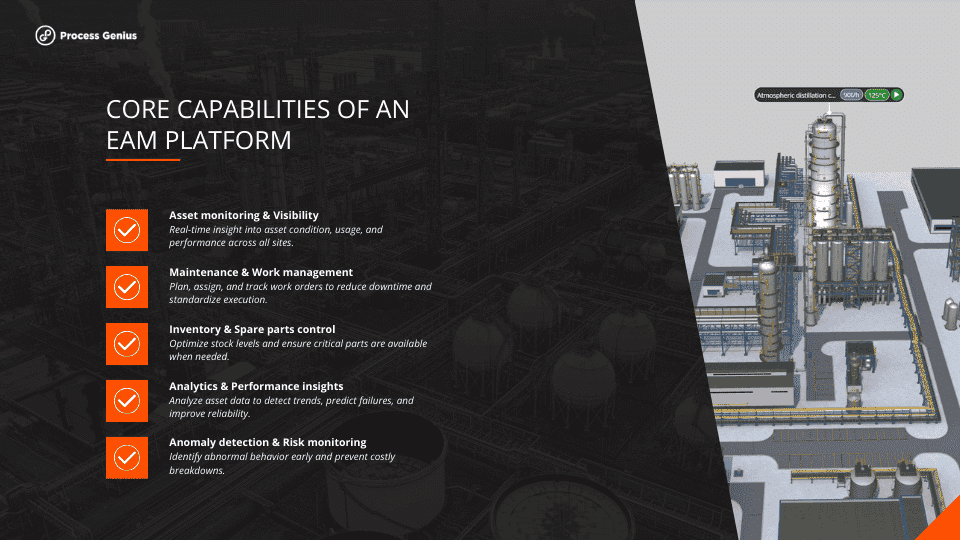
At its core, an EAM platform is designed to support effective EAM management across the entire asset lifecycle. Rather than focusing on a single function, it combines several capabilities that help organizations maintain asset reliability, compliance, and profitability over time.
Asset monitoring and visibility
One of the most essential features is asset monitoring and visibility. An EAM platform provides up-to-date information on the condition, usage, and status of assets across all facilities and departments. This visibility is increasingly supported by modern approaches to industrial monitoring that combine operational data, sensor inputs, and system integration. If you want to learn how monitoring has evolved beyond basic condition checks, this overview of the modern approach to industrial monitoring will provide you with useful information.
Maintenance and work management
Another key capability is maintenance execution and work management. EAM platforms enable teams to plan, assign, and track work orders, manage preventive maintenance schedules, and ensure consistent execution of inspections and repairs. Over time, this structured approach reduces unplanned downtime and helps organizations move from reactive, break-fix maintenance to more proactive methods
Inventory and spare parts management
Inventory and spare parts management is also tightly integrated into EAM platforms. By linking data on assets, work orders, and inventory, organizations can ensure that the necessary spare parts are available when needed, without creating overstocking or tying up capital in unused inventory. This connection between maintenance planning and materials management is an important component of scalable EAM management.
Analytics, performance insights, and anomaly detection
More advanced EAM platforms build on these operational foundations with analytics and performance insights. By analyzing historical maintenance data, asset usage patterns, and failure trends, organizations can identify weak points before they lead to disruptions. Capabilities like real-time anomaly detection help teams spot abnormal behavior early, enabling faster intervention and reducing the risk of costly breakdowns.
Finally, modern EAM platforms increasingly rely on industrial data analytics to transform raw asset data into useful information. Analytics help organizations compare asset performance across different sites, optimize maintenance intervals, and make long-term investment decisions. It is this data-driven approach that enables EAM to deliver sustained improvements in reliability, performance, and cost control, rather than short-term fixes.
Taken together, these capabilities explain why an EAM platform is more than a maintenance tool. It acts as a central system for managing assets strategically — balancing operational needs with long-term performance, risk, and value creation across the enterprise.
What are the Key Benefits of implementing Enterprise Asset Management solutions?
Implementing an enterprise asset management solution delivers value well beyond smoother maintenance operations. When EAM is adopted as a strategic system rather than a standalone tool, it directly supports performance, cost control, and long-term decision-making across the organization.
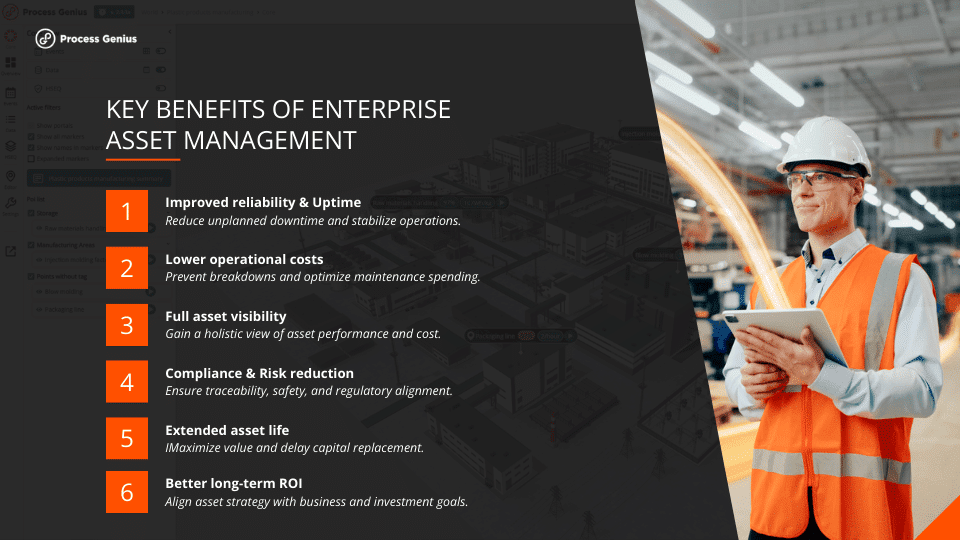
- One of the most immediate benefits is improved asset reliability and uptime. By standardizing maintenance processes, tracking asset condition, and scheduling preventive work, EAM helps organizations reduce downtime, avoid costly emergency repairs, and maintain more stable operations.
- Another major advantage is the ability to reduce operational costs and long-term maintenance expenses. Better planning, fewer breakdowns, and improved spare parts management all contribute to measurable cost savings over time. Over time, this has a measurable impact on overall production efficiency and profitability. Organizations looking to understand this connection in more detail can explore how structured asset management helps with controlling manufacturing costs in complex industrial environments.
- Enterprise asset management solutions also provide better visibility and control across the asset lifecycle. Decision-makers gain a holistic view of where assets are located, how they’re performing, and what they’re costing the business. This visibility makes it easier to prioritize investments, justify replacements, and extend asset life where it makes economic sense.
- Compliance and risk reduction are another important benefit, particularly in regulated industries. EAM solutions help ensure that inspections, certifications, and maintenance activities are documented and traceable. This reduces the risk of safety incidents, regulatory penalties, and operational disruptions caused by missed or poorly executed maintenance tasks. In many industrial environments, structured asset management also plays a key role in supporting broader health, safety, and environmental (HSE) performance, where equipment reliability and compliance directly impact worker safety and operational risk.
- Finally, EAM supports better long-term planning and ROI. By combining operational data with performance and cost insights, organizations can make informed decisions about capital investments, modernization programs, and maintenance strategies. Instead of reacting to failures, teams can focus on maximizing asset value over time and aligning asset management with broader business goals.
In short, an enterprise asset management solution helps organizations move from reactive asset maintenance to structured, data-driven asset management — improving reliability, controlling costs, and supporting sustainable operational performance at scale.
EAM vs. CMMS: what is the difference?
The difference between Enterprise Asset Management (EAM) and a Computerized Maintenance Management System (CMMS) comes down to scope, scale, and strategic focus.
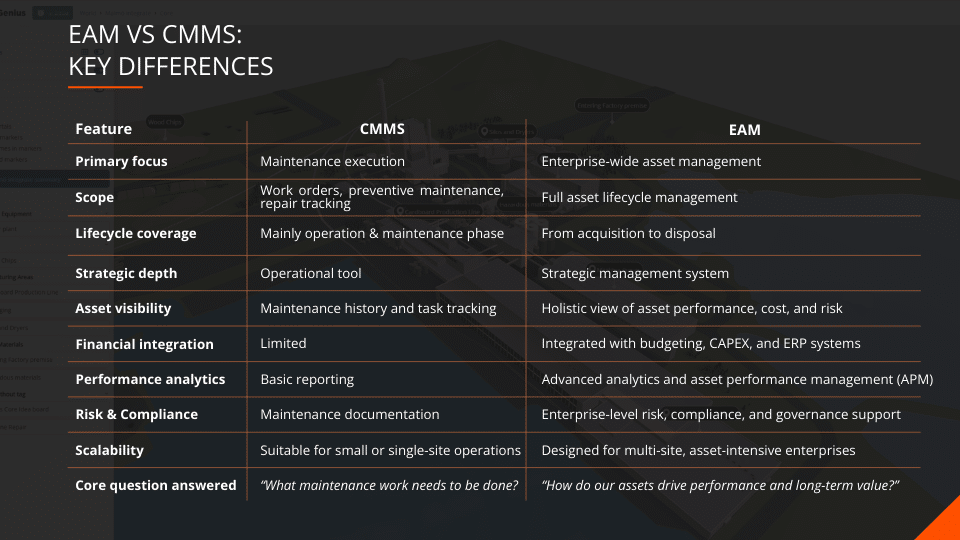
A CMMS is primarily designed to support maintenance execution. It helps maintenance teams manage work orders, schedule preventive maintenance, track repairs, and document maintenance activities. For smaller organizations or single-site operations, a CMMS can be an effective way to bring structure to day-to-day maintenance work.
EAM, on the other hand, takes a much broader view. While it includes all the core maintenance capabilities of a CMMS, it extends far beyond them. An EAM system is built to manage assets across their entire lifecycle — from acquisition and commissioning to optimization, compliance, and eventual replacement or disposal. It connects maintenance activities with financial planning, asset performance, risk management, and enterprise-wide reporting.
In practical terms, CMMS answers the question: “What maintenance work needs to be done?”. EAM answers a bigger one: “How do our assets contribute to performance, cost, and long-term business value?”
Why Organizations choose EAM Software over CMMS?
Many organizations start with CMMS—and this is often the right first step. But as operations become more complex, CMMS tools begin to show their limitations. This is where EAM software becomes the preferred choice.
One key reason is enterprise-wide visibility. EAM software provides a consolidated view of assets by location, department, and asset type. This level of visibility is difficult to achieve with CMMS, which is primarily focused on maintenance tasks rather than asset management strategy.
Another factor is lifecycle and cost management. EAM software links maintenance data to asset performance, lifecycle costs, and investment planning. This enables organizations to make informed decisions about repair or replacement, asset upgrades, and long-term capital expenditures—decisions that go beyond the typical application of CMMS tools.
Organizations also choose EAM software when integration becomes critical. EAM platforms are designed to integrate with ERP systems, financial tools, and asset performance management solutions, enabling a more coordinated and data-driven approach to operations. This integration is critical for aligning maintenance execution with budgeting, procurement, and performance optimization.
Finally, EAM software supports a more strategic approach to asset management. Instead of reacting to failures, organizations can standardize processes, manage risk, improve compliance, and continuously optimize asset performance over time. For asset-heavy industries, this shift from operational tracking to strategic management is often the decisive factor in moving from CMMS to EAM.
EAM in Industry: Use Cases and Specialized Applications
The importance of EAM in industry becomes most obvious when looking at how different sectors apply asset management to solve their specific operational challenges. Although the basic principles of EAM remain the same, the ways in which systems are configured and used often varies significantly depending on regulatory requirements, asset criticality, and operational complexity.
EAM in manufacturing
In manufacturing, EAM is typically used to manage production equipment, tools, and facilities across multiple plants. Here, the focus is on maximizing uptime, coordinating maintenance between shifts, and reducing the impact of unplanned downtime on productivity. EAM helps manufacturers standardize maintenance practices, improve reliability, and make data-driven decisions about asset replacement and upgrades.
EAM in energy sector
In energy, utilities, and infrastructure-intensive industries, EAM plays a vital role in managing geographically distributed assets such as power plants, substations, pipelines, and networks. These organizations rely on EAM to support inspection programs, regulatory compliance reporting, and long-term asset planning, often over decades of asset lifecycles.
EAM in logistics and transportation
In logistics and transportation, where large numbers of assets are used, EAM is used to manage fleets, terminals, and supporting infrastructure. In these environments, asset availability, safety, and regulatory compliance are closely interconnected, making structured asset management essential to maintaining service levels and controlling operational risks.
Across all these sectors, industrial EAM enables the transition from reactive maintenance to standardized, performance-driven asset management, helping organizations balance reliability, cost, and long-term value.
Healthcare Asset Management: vital for patient safety
Healthcare asset management is a specialized but increasingly important application of EAM, where asset reliability directly impacts patient safety and the quality of care.
Hospitals and healthcare providers manage a wide range of critical assets, from imaging equipment and surgical instruments to infusion pumps, laboratory systems, and facility infrastructure. An EAM system helps ensure that these assets are properly maintained, calibrated, and available when needed, reducing the risk of delays or equipment failures in clinical settings.
Healthcare asset management also plays a key role in ensuring regulatory compliance. Medical devices are subject to strict requirements for inspection, maintenance, and documentation. EAM platforms support traceability by recording maintenance history, certifications, and inspection results, making it easier to demonstrate compliance during audits and inspections.
In addition to ensuring regulatory compliance, EAM enables healthcare organizations to improve asset utilization and cost control. By understanding how often equipment is used, where bottlenecks occur, and which assets are underutilized, hospitals can make more effective decisions about purchasing, sharing equipment between departments, and capital investments.
In an environment where reliability, safety, and efficiency are non-negotiable, healthcare asset management with EAM provides the structure and transparency needed to protect patients and optimize operations.
The Future of Asset Maintenance: EAM and 3D Digital Twins
Enterprise organizations often use multiple systems to manage assets, operations, and resources, which can lead to confusion in terminology. EAM, ALM, and ERP play different roles, and understanding their differences helps clarify where enterprise asset management fits into the broader technology landscape.
Enterprise asset management (EAM) focuses on managing physical assets throughout their lifecycle. Its primary goal is to ensure the reliability, safety, compliance, and profitability of assets throughout their useful life. EAM links maintenance activities to asset performance, lifecycle costs, and long-term planning, making it particularly valuable in capital-intensive industries.
Asset lifecycle management (ALM) is a broader concept that considers the lifecycle of assets from a strategic perspective. Depending on the context, ALM can refer to high-level management of physical assets or, in some organizations, management of software and digital assets. ALM typically emphasizes lifecycle planning, investment decisions, and long-term value rather than day-to-day maintenance.
Enterprise resource planning (ERP) systems serve a different purpose. ERP platforms are designed to manage core business processes such as finance, procurement, human resources, and supply chains. Although ERP systems often store financial data related to assets, such as purchase costs, depreciation, and budgeting, they are not designed to handle detailed maintenance workflows or track asset performance in real time.
In practice, these systems are not competitors. On the contrary, they are most effective when used together. EAM manages asset health and performance, ALM supports long-term lifecycle and investment planning, and ERP provides the financial and organizational foundation that connects asset management to the rest of the company.
For organizations with complex operations involving large numbers of assets, 3D Digital Twins often act as an integrating layer, helping to connect EAM with ERP while aligning both approaches with broader ALM principles. This makes it easier to maintain a single, comprehensive view of assets, from financial planning and lifecycle decisions to operational execution and long-term value management.
Selecting the right EAM services and implementation partners
Choosing the right EAM services and implementation partners is often just as important as choosing the EAM platform itself. Even the most sophisticated software will fail to meet expectations if it is poorly configured, poorly integrated, or does not match the actual operating conditions of the organization.
Industry expertise
A strong EAM partner must have not only technical knowledge, but also an understanding of the industry and operational activities. Asset management requirements vary significantly across industries, and effective implementation depends on understanding asset criticality, regulatory constraints, maintenance practices, and operational realities. Partners with hands-on experience in asset-intensive environments are better equipped to translate business needs into practical system configurations.
Implementation approach
Another key factor is the partner’s approach to implementation and change management. EAM implementation typically involves multiple teams, from maintenance and operations to finance and IT. Successful EAM services focus on process design, data quality, and user adoption, not just system installation. This includes preparing asset data, defining workflows, and providing training that reflects real-world usage rather than generic templates.
Integration capabilities
Integration capabilities are also important when evaluating EAM services. Most organizations need their EAM system to interact seamlessly with ERP platforms, monitoring systems, and analytics tools. Implementation partners must be able to support such integration and ensure consistency of asset, financial, and operational data across all systems.
Long-term support and scalability
Long-term support and scalability should not be overlooked. Asset management is not a one-time project, but an ever-evolving discipline. The right EAM service partner can support ongoing optimization, system upgrades, and process improvements as operational needs change and the asset portfolio grows.
At the end of the day, choosing the right EAM services and implementation partners is about finding the right balance between technical capabilities and operational understanding. Organizations that view implementation as a strategic initiative rather than a purely technical implementation are more likely to realize the full value of enterprise asset management over time.
Selecting EAM services often raises practical questions about scope, integration, and long-term fit. If you need support or want to talk through your options, you’re welcome to reach out and discuss your situation.
Enterprise Asset Management FAQs

Digital Marketing & Business Specialist