
What Is Asset Performance Management (APM)?
APM is a strategic framework to optimize the reliability, availability, and efficiency of physical assets throughout their lifecycle.
- How Asset Performance Management differs from EAM and CMMS
- Core components of an Asset Performance Management system
- Key Metrics in Asset Performance Management
- Benefits of Asset Performance Management for Enterprise Organizations
- How to implement Asset Performance Management successfully
- Asset Performance Management FAQs
Asset Performance Management (APM) is a strategic approach to improving the reliability, availability, and overall performance of physical assets. It combines data, analytics, and engineering insight to help organizations predict failures, reduce risk, and optimize how assets perform over time.
Unlike traditional maintenance systems that focus mainly on tracking work orders or scheduling routine tasks, APM is centered on performance outcomes. Its purpose is not just to maintain equipment, but to ensure assets operate at their highest possible efficiency, with minimal disruption and risk.
At its core, asset performance management is about answering three key questions:
- How well are our assets performing right now?
- Where are we most at risk of failure?
- What actions will improve reliability and reduce long-term costs?
To answer these questions, APM systems use condition monitoring data, predictive analytics, and risk-based models. Instead of reacting to breakdowns or following fixed maintenance intervals, organizations can make decisions based on actual asset condition, performance trends, and criticality.
APM and reliability
Reliability is the foundation of asset performance management. APM helps teams identify weak points in equipment, understand recurring failure patterns, and prioritize high-risk assets. By analyzing real-time and historical data, organizations can prevent failures before they occur and extend asset life in a controlled, measurable way. This shift from reactive to predictive and risk-based maintenance is what differentiates APM from basic maintenance tracking tools.
APM and risk-based maintenance
Not all assets carry the same level of operational risk. Some failures cause minor inconvenience, while others can halt production, create safety hazards, or lead to significant financial losses. APM introduces risk-based maintenance by combining: asset criticality, probability of failure and consequence of failure.
This allows organizations to focus resources where they matter most. Instead of treating all equipment equally, teams can prioritize high-impact assets and allocate maintenance budgets more strategically.
APM and data-driven decision-making
Modern asset performance management relies heavily on data. Sensors, industrial control systems, and monitoring tools generate continuous streams of information about temperature, vibration, pressure, runtime, and more. APM platforms transform this raw data into insights. Through predictive models and performance dashboards, organizations gain visibility into asset health, performance trends, and potential failure risks. This enables smarter decisions about repairs, replacements, and capital investments.
How Asset Performance Management differs from EAM and CMMS
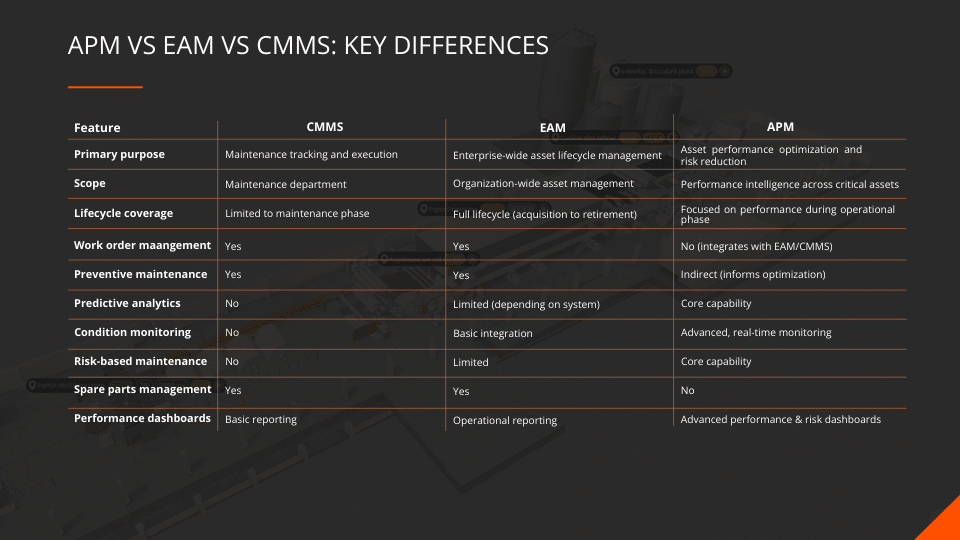
Asset Performance Management (APM), Enterprise Asset Management (EAM), and Computerized Maintenance Management Systems (CMMS) are closely related — but they are not the same thing. Understanding the differences is essential, especially for enterprise organizations that rely on asset-intensive operations. Each system serves a different purpose, and together they form a layered approach to asset management.
APM vs EAM
Enterprise Asset Management provides the structural framework for managing assets from acquisition to retirement. It handles asset records, work orders, preventive maintenance schedules, spare parts, compliance documentation, and reporting. In short, EAM ensures that maintenance and asset-related processes run in a structured and consistent way across the organization.
Asset Performance Management operates at a different level. Rather than executing maintenance tasks, APM analyzes asset condition and performance data to predict failures and reduce operational risk. It uses tools such as:
- Predictive analytics
- Condition monitoring
- Risk-based maintenance models
- Performance dashboards
While EAM systems execute work orders and manage maintenance workflows, APM identifies which assets are most likely to fail and why. You can think of it this way:
- EAM organizes and executes maintenance.
- APM decides where performance improvements and risk mitigation efforts should focus.
APM complements EAM by adding a layer of intelligence that helps organizations optimize asset reliability within the broader lifecycle framework.
APM vs CMMS
The difference between APM and CMMS is even more distinct. A Computerized Maintenance Management System (CMMS) is primarily a maintenance tracking tool. It helps teams:
- Log and manage work orders
- Schedule preventive maintenance
- Track repair history
- Manage spare parts
CMMS improves maintenance organization and documentation, but it does not typically analyze asset health in depth or predict failures using advanced analytics.
For a detailed comparison between CMMS and broader enterprise solutions, see our guide on CMMS vs EAM. Asset Performance Management goes further by focusing on:
- Failure prediction
- Asset risk scoring
- Real-time condition monitoring
- Long-term performance optimization
Instead of asking, “What maintenance task needs to be completed?” APM asks, “Which asset is most likely to fail, and what is the business risk if it does?”
In summary:
- CMMS tracks maintenance activity.
- EAM manages the full asset lifecycle and operations.
- APM predicts performance risks and drives reliability improvements.
For enterprise organizations aiming to reduce downtime and improve operational resilience, APM adds the intelligence layer that transforms maintenance from reactive execution into proactive performance management.
Core components of an Asset Performance Management system
An Asset Performance Management (APM) system is built on several technical layers that work together to improve reliability and reduce risk. While the goal is simple — better asset performance — the underlying structure combines real-time data collection, advanced analytics, and structured decision models. Below are the core components that define a modern APM system.
Condition monitoring and machine health data
At the foundation of APM is condition monitoring. This is the continuous tracking of asset health using operational and sensor data. Modern industrial assets generate large amounts of information, including:
- Vibration levels
- Temperature readings
- Pressure measurements
- Lubrication quality
- Runtime and load data
- IoT sensor inputs
This process is often referred to as machine condition monitoring. Instead of relying solely on scheduled inspections, organizations can monitor assets in real time and detect early warning signs of deterioration. As monitoring technologies evolve, companies are moving beyond isolated sensor checks toward more integrated data environments. If you want to explore how industrial monitoring has developed, see our article on A Modern Approach to Industrial Monitoring.
By monitoring assets across sites, companies gain visibility into how equipment performs in different operating conditions. This creates a consistent performance baseline and allows teams to detect deviations before they lead to failures. Condition monitoring is also the foundation for predictive maintenance, as it provides the raw data required for forecasting future breakdowns.
Predictive analytics and failure forecasting
Raw data alone does not improve reliability. The real value of an APM system comes from predictive analytics.
Using historical maintenance records, sensor inputs, and performance trends, APM platforms apply statistical models and machine learning algorithms to identify patterns that humans might miss. These models can detect anomalies — subtle changes in vibration, temperature, or efficiency — that signal an increased probability of failure. This type of advanced analysis is part of a broader industrial data strategy. If you want to explore how manufacturing organizations transform raw operational data into decision-ready insight, see our guide on industrial data analytics.
This enables failure forecasting. Instead of reacting after a breakdown, organizations can intervene at the optimal time. Predictive analytics supports predictive maintenance strategies by answering questions such as:
- When is this component likely to fail?
- What is the expected remaining useful life?
- Which failure mode is most probable?
By combining real-time machine condition monitoring with predictive analytics, APM systems shift maintenance from time-based schedules to condition-based and risk-based decisions.
Risk-based Asset prioritization
Not every asset deserves the same level of attention. Some failures are inconvenient; others are catastrophic. A key component of APM is risk-based asset prioritization. This approach evaluates assets based on Asset criticality, Probability of failure, Consequence of failure. Criticality models assign risk scores to assets based on their impact on safety, production, compliance, and financial performance. This ensures that maintenance resources are directed toward equipment that poses the highest operational risk.
For example, a production bottleneck machine or a safety-critical system may receive continuous monitoring and advanced predictive modeling, while low-impact assets may follow simpler maintenance routines. By aligning maintenance priorities with business risk, APM improves overall operational performance while controlling costs.
Performance Dashboards and KPIs
The final layer of an Asset Performance Management system is visibility. APM platforms provide performance dashboards that translate technical data into clear, actionable insights for both maintenance teams and management. These dashboards typically track:
- Asset availability
- Mean Time Between Failures (MTBF)
- Mean Time To Repair (MTTR)
- Downtime trends
- Reliability indices
- Risk exposure levels
This structured performance reporting enables organizations to monitor assets across sites and compare reliability metrics between facilities, departments, or production lines. More importantly, it supports continuous improvement. Teams can measure the impact of predictive maintenance initiatives, evaluate reliability improvements over time, and refine their strategy based on measurable results. In combination, these four components — condition monitoring, predictive analytics, risk prioritization, and performance dashboards — form the technical backbone of a modern Asset Performance Management system.
Key Metrics in Asset Performance Management
Asset Performance Management is not only about collecting data — it is about proving performance improvement in measurable terms. While APM systems provide dashboards and reporting tools, organizations need clearly defined performance metrics to evaluate whether their reliability strategy is delivering results. These metrics connect technical asset health to operational and financial outcomes.
Mean Time Between Failures (MTBF)
Mean Time Between Failures measures how long an asset operates before a breakdown occurs. In an APM context, MTBF is used to evaluate the effectiveness of predictive maintenance and reliability initiatives. An increasing MTBF over time signals that failure prevention strategies are working. Rather than being just a reporting figure, MTBF becomes a benchmark for continuous reliability improvement.
Mean Time To Repair (MTTR)
Mean Time To Repair reflects how quickly an organization can restore operations after a failure. Even with strong predictive analytics, not all failures can be avoided. APM uses MTTR to assess response efficiency, spare parts readiness, and maintenance coordination. Reducing MTTR minimizes operational disruption and limits financial impact.
Overall Equipment Effectiveness (OEE)
Overall Equipment Effectiveness combines availability, performance rate, and quality output into a single productivity indicator. Within Asset Performance Management, OEE helps organizations evaluate how reliability improvements translate into real operational gains. It highlights hidden losses that may not appear in simple downtime statistics. Improving OEE often requires both technical optimization and smarter maintenance prioritization.
Asset availability
Asset availability measures how consistently equipment is ready for use when required. APM aims to maximize availability through early fault detection, condition-based interventions, and risk-based prioritization. Availability improvements directly impact production stability and service continuity.
Asset reliability index
An asset reliability index aggregates multiple indicators — failure rates, condition trends, and maintenance history — into a structured reliability score. This allows enterprises to compare performance across facilities, asset classes, or geographic regions. It also helps identify systemic reliability weaknesses that require strategic intervention.
Cost of downtime
The cost of downtime translates technical failures into financial impact. APM connects operational disruptions to lost production, emergency repair costs, safety risks, and reputational damage. By quantifying downtime financially, organizations can justify investments in predictive analytics and reliability programs. This is where performance management directly aligns with executive-level decision-making.
Risk Exposure Index
A risk exposure index measures the potential business impact of asset failure by combining probability and consequence. In Asset Performance Management, this metric guides risk-based maintenance decisions. Assets with higher exposure receive more intensive monitoring and predictive modeling. This ensures maintenance resources are allocated based on operational and financial risk — not just historical schedules
Benefits of Asset Performance Management for Enterprise Organizations
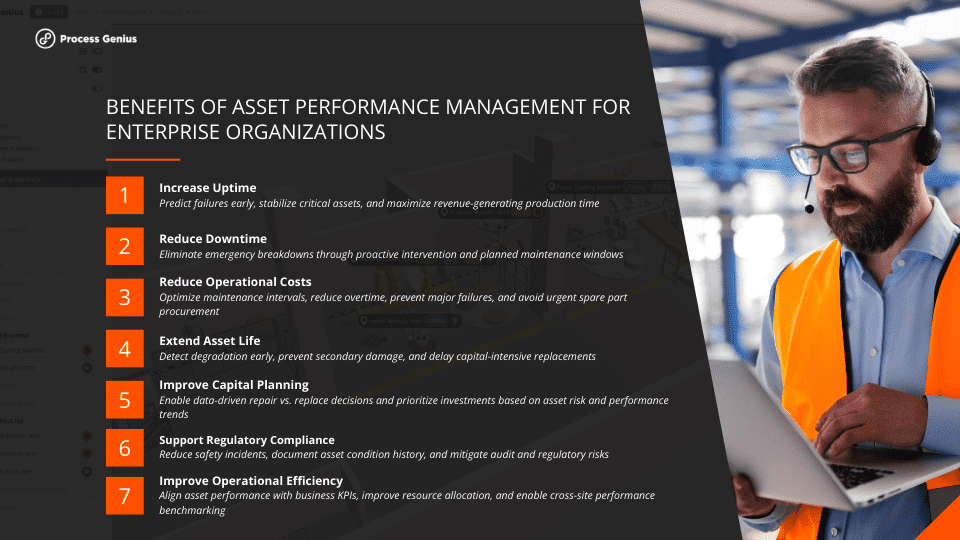
For enterprise organizations, Asset Performance Management is not just a technical upgrade — it is a strategic lever. When implemented effectively, APM improves reliability, reduces risk, and strengthens financial performance across the entire operation. Below are the most significant benefits enterprises gain from adopting a structured APM approach.
Increase productive uptime
One of the primary goals of Asset Performance Management is to maximize productive uptime. By using condition monitoring and predictive analytics, organizations can detect early signs of wear or failure and intervene before disruptions occur. This prevents unexpected stoppages and keeps critical equipment running under stable conditions. Higher uptime means:
- More consistent production output
- Better service levels
- Improved customer satisfaction
For asset-intensive industries, even small improvements in uptime can have a significant impact on revenue.
Reduce unplanned downtime
Unplanned downtime is one of the most expensive operational risks enterprises face. APM reduces downtime by identifying high-risk assets and predicting failures before they happen. Instead of reacting to breakdowns, teams can plan maintenance during scheduled windows and avoid emergency interventions. Reducing unplanned downtime leads to:
- Lower emergency repair costs
- Fewer production interruptions
- Reduced operational stress on teams
This shift from reactive maintenance to predictive decision-making is a core advantage of APM. In manufacturing environments especially, downtime, quality losses, and reactive maintenance all contribute directly to rising manufacturing costs.
Reduce operational costs
Operational costs often increase due to inefficient maintenance, frequent failures, and poor resource allocation. Asset Performance Management improves cost control by:
- Optimizing maintenance intervals
- Preventing major failures
- Reducing overtime and urgent spare part procurement
- Prioritizing high-risk assets
When maintenance activities are aligned with actual asset condition and risk exposure, organizations avoid unnecessary work while focusing resources where they create the most value.
Extend asset life
Replacing high-value industrial assets is capital-intensive. APM helps organizations extend asset life through early fault detection and performance optimization. By continuously analyzing machine health data and failure patterns, enterprises can:
- Address degradation before it escalates
- Avoid secondary damage caused by delayed repairs
- Maintain stable operating conditions
Extending asset life improves return on investment and delays costly capital expenditures.
Improve capital planning
Asset Performance Management provides data-driven insight into long-term reliability trends and cost behavior. With clear performance and risk metrics, leadership teams can make informed decisions about:
- Repair versus replacement
- Equipment upgrades
- Asset modernization programs
- Budget allocation
Instead of relying on reactive replacement cycles, capital planning becomes proactive and evidence-based.
Support regulatory compliance
In regulated industries, equipment reliability is closely linked to safety and compliance. APM supports compliance by:
- Documenting asset condition and maintenance history
- Identifying high-risk failure scenarios
- Reducing safety incidents caused by unexpected breakdowns
By managing performance risks systematically, organizations lower the likelihood of regulatory violations and operational disruptions.
Improve operational efficiency
At a broader level, Asset Performance Management enhances operational efficiency. When assets perform reliably and predictably:
- Production schedules are more stable
- Maintenance teams work more strategically
- Spare parts inventory is better aligned with real needs
- Cross-site performance comparisons become possible
APM connects technical performance with business performance. It ensures that assets not only function — but function optimally, consistently, and profitably. For enterprise organizations operating at scale, these benefits compound over time, turning asset reliability into a competitive advantage rather than a constant operational risk.
How to implement Asset Performance Management successfully
Implementing Asset Performance Management is not just a software project — it is an operational transformation. Technology plays a key role, but long-term success depends on data quality, system integration, and organizational alignment. Below are the core elements that determine whether an APM initiative delivers measurable results.
Start with strong data preparation
APM depends on accurate, structured, and complete asset data. Without reliable input, even the most advanced predictive models will produce weak insights.
Effective data preparation includes:
- Cleaning and standardizing asset records
- Verifying equipment hierarchies and criticality ratings
- Consolidating maintenance history
- Validating sensor and condition monitoring inputs
Organizations often underestimate this step. However, structured data preparation ensures that performance models reflect real operating conditions and produce meaningful risk assessments. High-quality data is the foundation for optimizing asset quality over time.
Integrate APM with EAM and ERP systems
Asset Performance Management should not operate in isolation. It must integrate seamlessly with existing enterprise systems. In many industrial environments, this integration is part of a broader shift toward connected operations. If you’re exploring how systems, machines, and enterprise platforms work together in real time, our guide to understanding connected manufacturing provides a helpful overview.
Integration with Enterprise Asset Management ensures that:
- Predictive insights automatically trigger work orders
- Maintenance schedules reflect real-time risk levels
- Asset performance data feeds lifecycle decision-making
In addition, integration with ERP systems aligns asset performance with financial planning, procurement, and budgeting processes. Performance data becomes part of capital planning and cost control strategies rather than remaining purely operational. When APM, EAM, and ERP systems are aligned, enterprises gain a unified view of operational performance and financial impact.
Prioritize change management
Even the most advanced APM platform will fail without user adoption. Maintenance teams, reliability engineers, and operations managers must trust the predictive models and incorporate them into daily decision-making. This requires:
- Clear communication of goals
- Defined ownership of performance metrics
- Practical training focused on real workflows
- Leadership support across departments
Change management ensures that predictive insights are not ignored or overridden by traditional reactive habits.
Summarize and refine APM models
APM is not a one-time implementation. It is an evolving system that improves over time.
Predictive models must be refined as more operational data becomes available. Organizations should regularly evaluate:
- Prediction accuracy
- False-positive rates
- Asset criticality assumptions
- Risk scoring thresholds
This process of iterating EAM and APM strategies strengthens reliability models and improves long-term accuracy. Continuous refinement allows enterprises to adapt to changing operational conditions and new asset behaviors.
Align maintenance and operations
A common barrier to performance improvement is misalignment between maintenance and operations teams. APM helps bridge this gap by providing shared performance indicators and transparent risk assessments. When both teams operate from the same data-driven insights, they can:
- Schedule maintenance at optimal times
- Reduce conflict between uptime targets and preventive interventions
- Coordinate risk mitigation strategies
Alignment transforms maintenance from a cost center into a strategic contributor to operational performance.
Enable continuous asset optimization
Successful APM implementation does not end once dashboards are live. The ultimate goal is continuous asset optimization. By combining data preparation, system integration, model refinement, and organizational alignment, enterprises create a feedback loop:
- Monitor asset performance
- Predict risk and failure
- Execute targeted interventions
- Measure results
- Refine models
This cycle drives sustained reliability improvements, cost control, and operational resilience. When implemented strategically, Asset Performance Management becomes more than a maintenance tool. It becomes a long-term framework for optimizing asset quality, reducing risk exposure, and strengthening enterprise performance at scale.
Asset Performance Management FAQs

Digital Marketing & Business Specialist