
Original Equipment Manufacturers (OEMs) face growing pressure to deliver reliable products, control operating costs, and support equipment throughout their lifecycle. Yet many OEMs struggle to maintain visibility once their machines leave the factory and enter customer operations.
Equipment performance data may be spread across different systems, service teams may lack timely information about failures, and dealers may have limited access to the technical details they need. These gaps can make maintenance planning, spare-parts coordination, and customer support more difficult and expensive.
For OEMs that manufacture and service industrial equipment, Digital Twin technology offers a way to bring relevant equipment information into a connected digital environment. When integrated with operational data and business systems, a Digital Twin can help teams monitor equipment, investigate problems, coordinate service activities, and make better-informed lifecycle decisions.
These capabilities reflect the growing role of Digital Twins in manufacturing, where connected equipment information supports better visibility, coordination, and decision-making across industrial operations.
This article examines five common OEM manufacturing challenges, explains how Digital Twins can help address them, and outlines practical considerations for implementation.
What are the main challenges in OEM manufacturing?
Original Equipment Manufacturers face challenges that extend beyond designing and producing equipment. For OEMs responsible for installation, maintenance, or aftermarket support, managing equipment across multiple customer sites adds another layer of complexity.
Five common challenges are:
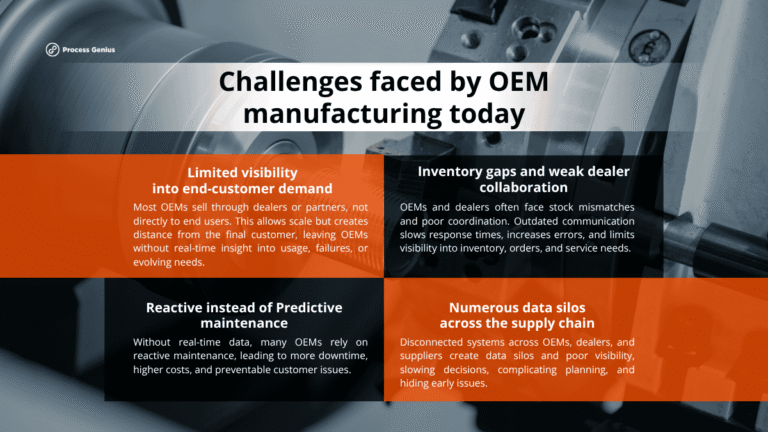
1. Limited equipment visibility.
Once equipment is installed at a customer site, OEMs may have limited access to real-time performance data, making it difficult to identify developing problems or understand how machines are being used.
2. Reactive maintenance and costly field service.
Without timely equipment information, service teams may only learn about failures after they occur, leading to unplanned interventions, longer repair times, and higher service costs. Predictive maintenance can help OEMs identify developing equipment problems earlier and plan service activities before failures disrupt customer operations.
3. Spare-parts availability and inventory coordination.
OEMs must balance parts availability against inventory costs while coordinating demand across warehouses, service teams, and dealer networks.
4. Dealer and customer collaboration.
Disconnected communication channels and inconsistent access to technical information can delay troubleshooting, service coordination, and issue resolution.
5. Disconnected operational data.
Equipment data, maintenance records, production information, and business systems often operate separately, limiting the ability to make informed decisions across the equipment lifecycle.
These challenges are closely connected. Limited visibility can delay maintenance, poor data integration can complicate spare-parts planning, and fragmented information can make collaboration harder. Addressing them requires more than collecting additional data; OEMs need a practical way to connect information with the equipment, people, and processes that depend on it.

Limited visibility into equipment and product performance
For many industrial equipment OEMs, visibility becomes more limited once machines are delivered and installed at customer sites. Equipment may operate in different locations, under different conditions, and with varying levels of access to operational data.
This creates a challenge for OEMs that provide ongoing maintenance, technical support, or aftermarket services. Without reliable information about equipment condition and usage, service teams may struggle to understand why a machine is underperforming, identify recurring problems, or determine when intervention is needed.
The challenge becomes greater when OEMs work through dealers and distributors. Information about equipment performance, service history, and customer needs may be spread across several organizations and systems. As a result, the manufacturer may have an incomplete picture of how its products perform throughout their operational lives.
How Digital Twins improve equipment visibility
A Digital Twin can connect a visual representation of industrial equipment with relevant operational information, giving authorized users a clearer view of machine status, performance, and usage.
When equipment is connected through sensors and industrial data systems, remote monitoring allows OEMs and service partners to access available machine information without being physically present at the customer site.
For example, service teams may be able to:
- Monitor operating conditions such as temperature, pressure, and machine speed.
- Identify unusual changes in equipment behavior.
- Review available performance and operating-history data.
- Investigate reported problems before arranging an on-site visit.
- Share relevant equipment information with authorized dealers and customer teams.
These capabilities can help OEMs respond to equipment issues more effectively and improve the quality of aftermarket support. They can also provide useful insights for future product improvements.
However, a Digital Twin does not automatically provide access to every machine or customer site. The available visibility depends on equipment connectivity, data integration, and the information customers agree to share.

Reactive maintenance and costly field service
Industrial equipment OEMs often remain responsible for technical support, repairs, and maintenance long after their machines have been delivered. When equipment operates across multiple customer sites, however, service teams may have limited information about its condition until a problem is reported.
This can create a reactive maintenance cycle. A machine fails, the customer contacts the OEM or dealer, and technicians must investigate the issue before deciding what repairs, replacement parts, or specialist support are needed.
For OEMs and their customers, this approach can lead to several problems:
- Longer equipment downtime: Troubleshooting and arranging repairs can delay the return to normal operations.
- Higher service costs: Unplanned site visits, urgent spare-parts shipments, and repeated interventions increase expenses.
- Inefficient technician scheduling: Service teams may have to respond to emergencies instead of carrying out planned work.
- Customer dissatisfaction: Unexpected failures can disrupt production and weaken confidence in equipment reliability.
How Digital Twins support proactive maintenance and service
A Digital Twin can help OEM service teams understand equipment problems before technicians arrive on-site. By bringing together available operating data, maintenance history, technical documentation, and equipment information, it provides a more complete context for troubleshooting.
For example, when a customer reports abnormal machine behavior, a technician may be able to review recent operating conditions, examine previous maintenance records, and identify relevant components within a 3D equipment model.
When combined with condition monitoring and appropriate analytics, this information can also help teams recognize developing faults and schedule maintenance before equipment fails.
Digital Twins can support more efficient field service by helping OEMs:
- Investigate reported faults remotely before dispatching technicians.
- Identify likely problem areas and prepare the necessary tools or spare parts.
- Coordinate maintenance activities with dealers and local service partners.
- Access relevant equipment documentation and service history.
- Track recurring failures and use the findings to improve future maintenance plans.
For OEMs with extensive installed equipment fleets, these capabilities can contribute to reducing equipment downtime and improving service efficiency.
The value depends on the quality of the available data and how well the Digital Twin connects with maintenance and service workflows. A 3D model alone cannot predict failures or replace the expertise of maintenance professionals.

Spare-parts availability and inventory coordination
Managing spare-parts availability is a major challenge for industrial equipment OEMs, particularly when machines are installed across multiple customer sites and supported through independent dealers or service partners.
OEMs need to ensure that critical replacement parts are available when equipment requires maintenance. However, keeping large inventories across multiple locations ties up capital and increases storage costs. Insufficient stock, on the other hand, can delay repairs and extend customer downtime.
The problem becomes more complicated when OEMs have limited visibility into dealer inventories. A manufacturer may know which parts have been shipped to a dealer but not how many remain available, which components are being used most frequently, or where shortages are developing.
This can lead to several operational problems:
- Unexpected stockouts: Critical replacement parts may be unavailable when urgently needed.
- Excess inventory: Dealers and OEMs may hold more stock than necessary because demand is difficult to estimate.
- Delayed repairs: Service teams may identify a fault but have to wait for replacement components.
- Poor demand planning: Disconnected equipment, inventory, and service information makes it harder to anticipate future parts requirements.
How Digital Twins improve spare-parts coordination
A Digital Twin can help OEMs connect equipment information with inventory, maintenance, and service data, making it easier to understand which components are needed and where they are available.
For example, a technician investigating a machine fault could use a 3D Digital Twin to identify the affected component, review its technical information, and check replacement-part availability through an integrated inventory system.
This becomes particularly valuable when Digital Twins are connected with ERP, MES, and MRP systems, which support different aspects of production management, resource planning, and material requirements.
With the right integrations, OEMs and authorized service partners can:
- Identify replacement components using equipment-specific information.
- Check available spare-parts stock across connected locations.
- Coordinate parts requests with maintenance and service activities.
- Use equipment condition and service history to inform future parts planning.
- Improve communication between manufacturers, warehouses, dealers, and service teams.
These capabilities can help OEMs reduce unnecessary delays, improve parts availability, and make more informed inventory decisions.
However, a Digital Twin does not automatically manage inventory or forecast spare-parts demand. These functions depend on the connected business systems, available data, and planning or analytics capabilities.

Dealer and customer collaboration
Industrial equipment OEMs often rely on dealers, distributors, and service partners to deliver equipment, provide technical support, and maintain customer relationships. Effective collaboration between these organizations is essential, but information is not always shared efficiently.
In many OEM networks, communication still depends on emails, spreadsheets, and separate business systems. Dealers may struggle to obtain current information about equipment status, order progress, or technical documentation, while OEMs may have limited visibility into service requests and customer feedback.
These information gaps can create several challenges:
- Delayed service coordination: Dealers may need to contact the manufacturer repeatedly to obtain technical information or resolve customer issues.
- Inconsistent information: Different organizations may work with outdated equipment documentation, order details, or service records.
- Limited order visibility: Dealers may lack reliable updates about production progress and expected deliveries.
- Fragmented customer feedback: Information about recurring equipment problems may not reach OEM engineering and product development teams.
- Unclear data access: Sharing information across organizations requires appropriate permissions and clear responsibilities.
How Digital Twins improve dealer collaboration
A Digital Twin can provide a shared environment where OEMs, dealers, and authorized customer representatives access relevant equipment information.
When connected with production, service, and business systems, it can help different organizations work with more consistent and up-to-date information. This supports the principles of connected manufacturing, where information flows between equipment, systems, and the people responsible for industrial operations.
For example, an OEM could give a dealer access to Digital Twins representing the machines that dealer supports. Authorized users could then review relevant equipment documentation, available operating information, and service records without repeatedly requesting the same details from the manufacturer.
Depending on the integrations and permissions available, Digital Twins can help OEMs:
- Share equipment-specific technical documentation with dealers.
- Provide relevant machine status and service information to authorized partners.
- Improve coordination around customer support requests.
- Make production or delivery updates accessible through connected systems.
- Collect service feedback that supports product development and equipment improvements.
Access control is particularly important. Dealers should only see information relevant to the equipment and customers they are authorized to support.
By establishing clear data-sharing arrangements and connecting the appropriate systems, OEMs can improve collaboration without giving every partner unrestricted access to sensitive operational information.

Disconnected operational data
Industrial equipment OEMs often manage information across multiple systems, including production management software, maintenance platforms, inventory databases, and customer service applications. Each system serves a specific purpose, but the information they contain is not always connected.
This creates data silos that make it difficult to understand equipment performance and coordinate activities across the organization.
For example, a machine may generate operating data through sensors, while its maintenance history is stored in a separate service system. Spare-parts information may be held in an inventory database, and customer feedback may be recorded by a dealer.
Without connections between these sources, employees must search across different systems to understand the condition, history, and service requirements of a particular machine.
Common consequences include:
- Incomplete equipment visibility: Teams cannot easily combine operating conditions, maintenance history, and other relevant information.
- Manual data collection: Employees spend time searching for records and transferring information between systems.
- Slower decision-making: Important information may not reach the people who need it when problems occur.
- Inconsistent records: Different departments or partners may work with outdated or conflicting information.
- Limited lifecycle insights: OEMs struggle to connect equipment performance in the field with engineering, production, and service decisions.
How Digital Twins connect operational information
A Digital Twin can provide a common interface for accessing information associated with a specific machine, production system, or equipment fleet.
One important source is the Industrial Internet of Things (IIoT), which enables connected industrial equipment and sensors to exchange operational data. When this information is integrated with maintenance records, technical documentation, and relevant business systems, users can access a more complete view of equipment condition and history.
For example, an OEM service engineer investigating a recurring machine fault could use a Digital Twin to examine recent operating conditions alongside previous repairs and component information. Instead of searching several disconnected applications, the engineer can access the relevant information in the context of the affected equipment.
Connected information also creates opportunities for industrial data analytics, helping OEMs identify recurring faults, compare equipment performance, and recognize patterns that may otherwise remain hidden across separate datasets.
Depending on the available integrations, a Digital Twin can help OEMs:
- Bring together relevant information from equipment, maintenance, and business systems.
- Associate operating data and service records with individual machines or components.
- Give authorized teams access to consistent equipment information.
- Support troubleshooting and analysis using connected operational and historical data.
- Share insights between engineering, manufacturing, maintenance, and aftermarket service teams.
However, a Digital Twin does not eliminate data silos automatically. Successful integration requires compatible interfaces, reliable data, consistent equipment identifiers, and appropriate access permissions.
The goal is not necessarily to replace existing systems, but to make their information easier to access and use together.

How 3D Digital Twins support OEM operations
A 3D Digital Twin brings equipment information into a visual environment where OEM teams can explore machines, access relevant data, and understand how different components and systems relate to one another.
Unlike a standalone 3D model, an operational Digital Twin connects the equipment representation with information from external sources. Depending on the implementation, this may include sensor readings, maintenance records, technical documentation, component information, and service history.
For OEMs managing complex equipment and distributed service networks, this creates a practical way to organize information around the machines themselves rather than requiring users to navigate multiple disconnected applications.
Equipment information in a 3D context
Industrial machines often contain hundreds or thousands of components. Finding the correct information in traditional documentation or business systems can be time-consuming, especially for technicians who are unfamiliar with a particular machine configuration.
A 3D Digital Twin allows users to navigate a visual equipment model, locate relevant components, and access associated information.
For example, a service technician could select a component within the model to review available technical specifications, maintenance instructions, or operating data.
This makes the Digital Twin particularly useful for equipment troubleshooting, service preparation, and technical support.
Connecting information across the equipment lifecycle
OEMs work with equipment information at different stages, from engineering and manufacturing to installation, operation, and aftermarket service.
A Digital Twin can help connect these stages by associating information with the relevant equipment and components.
This requires more than simply displaying data. The relationships between machines, components, systems, and information sources must be defined consistently. Digital Twin ontology provides a framework for describing these relationships and giving connected information a clearer structure.
With appropriate data models and integrations, OEMs can make equipment information easier to interpret and reuse across different teams and lifecycle stages.
A shared environment for different users
The same equipment may be relevant to several groups, including OEM engineers, field-service technicians, dealers, and customer maintenance teams.
A 3D Digital Twin can provide these users with a common equipment reference while allowing access to different information according to their responsibilities.
For example, an OEM engineer may need detailed performance history, while a dealer technician may primarily need service instructions and information about replacement components.
Providing information in a shared visual context can reduce misunderstandings and help teams collaborate more effectively.
Turning equipment information into practical decisions
The value of a Digital Twin comes from how effectively connected information supports everyday work.
For OEMs, this may mean diagnosing equipment problems more quickly, preparing service visits more accurately, identifying recurring component issues, or using field-performance information to guide product improvements.
However, the 3D environment is only one part of the solution. Its usefulness depends on reliable data, appropriate integrations, clear information relationships, and workflows that help people act on what they see.
A well-designed Digital Twin therefore serves as a practical connection between equipment, information, and the people responsible for its performance.

How to implement Digital Twins in OEM manufacturing
Implementing Digital Twin technology does not require OEMs to connect every machine, system, and dealer at once. A gradual approach allows manufacturers to test the technology, address integration challenges, and demonstrate its value before expanding to additional equipment and locations.
The following steps provide a practical starting point for OEMs considering Digital Twin implementation.
1. Start with a focused pilot project
Choose a specific machine, equipment group, or service process where better visibility could deliver measurable benefits.
For example, an OEM might begin by connecting operating data from one machine model to a 3D Digital Twin. Service engineers could then use the pilot to review equipment status, access technical documentation, and investigate reported problems.
A focused pilot helps teams evaluate data quality, usability, integration requirements, and the potential benefits before committing to a wider rollout.
For a more detailed approach to planning and deployment, see our guide to Digital Twin implementation.
2. Connect the most relevant systems
A useful Digital Twin needs access to information that supports its intended purpose.
For an OEM, this may include sensor data, equipment documentation, maintenance records, ERP information, or data from a Dealer Management System (DMS).
Rather than integrating every available system immediately, prioritize the information required for the pilot. For example, a service-focused Digital Twin may initially need machine operating data, component documentation, and maintenance history.
Clear equipment identifiers and reliable data connections are essential for associating information with the correct machines and components.
3. Define data-sharing rules with dealers and customers
When Digital Twins support equipment installed at customer sites, data access must be agreed upon between the organizations involved.
OEMs should establish which information can be collected, who can access it, and how it may be used.
Dealers may need access to equipment documentation, service information, and relevant machine status data. OEM engineering teams may require different information to investigate recurring failures or improve future products.
Role-based permissions can help ensure that users access only the equipment and information relevant to their responsibilities.
4. Measure results and expand gradually
Before launching the pilot, define what success should look like.
Depending on the use case, useful indicators may include:
- Time required to investigate equipment faults.
- Number of service visits needed to resolve an issue.
- Time spent locating technical documentation.
- Availability and quality of equipment data.
- Feedback from service engineers, dealers, and customers.
Review the results and address technical or operational problems before connecting additional equipment, systems, or partner organizations.
As the Digital Twin environment expands, OEMs should also establish processes for updating equipment models, maintaining integrations, and managing user access.
A successful implementation is not simply about creating more Digital Twins. It is about ensuring that connected equipment information remains accurate, accessible, and useful as business needs evolve.
Digital Twin solutions for OEMs: Genius Core®
Addressing OEM manufacturing challenges requires more than collecting equipment data. Manufacturers also need a practical way to organize information, make it accessible to the right people, and connect it with everyday service and operational workflows.
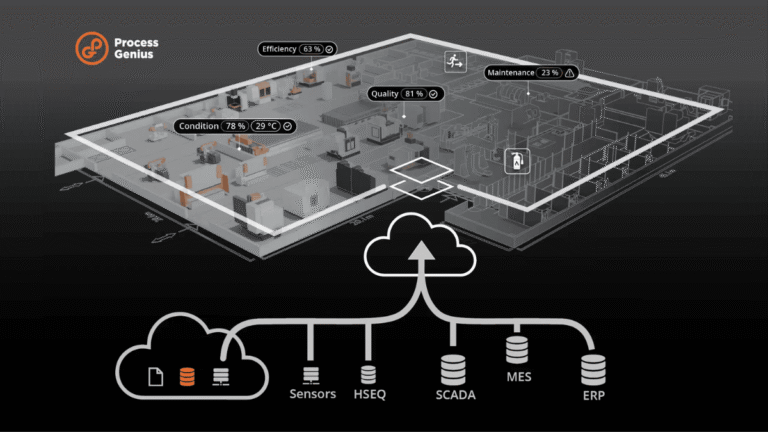
Genius Core®, the 3D Digital Twin platform developed by Process Genius, helps industrial OEMs bring equipment information into a shared visual environment.
By connecting 3D equipment models with relevant operational data and business systems, the platform can support equipment monitoring, technical troubleshooting, and collaboration between OEMs, dealers, and customers.
Equipment visibility through an interactive 3D environment
Genius Core allows users to explore equipment through a 3D interface and access information associated with individual machines or components.
When connected to available data sources, the platform can display relevant operating conditions, equipment status, and other information that supports monitoring and troubleshooting.
This helps OEM service teams understand equipment in its physical context instead of relying exclusively on separate dashboards, documentation, or data tables.
Connected information in one environment
OEMs often work with information from multiple systems, including industrial equipment, maintenance applications, and business software.
Genius Core can bring information from connected sources into a shared environment. Its data layout functionality allows users to organize and access information relevant to their tasks.
For example, a service engineer may need machine operating data and technical documentation, while a dealer may need equipment-specific service information.
The available information depends on which systems are integrated and what data they provide.
Controlled access for dealers and service partners
OEMs need to collaborate with external organizations without exposing all their operational information.
Genius Core supports role-based access, allowing OEMs to manage which information different users can access.
For example, an OEM can provide a dealer with access to the equipment that dealer supports while restricting access to unrelated machines or information.
This makes it possible to establish a shared equipment environment while maintaining appropriate boundaries between customers, dealers, and internal teams.
A scalable approach to Digital Twin adoption
OEMs do not need to begin with their entire installed equipment fleet.
Genius Core supports a gradual approach in which manufacturers can start with selected equipment and expand their Digital Twin environment as their requirements develop.
As additional machines, data sources, and users are introduced, OEMs can build on the initial implementation rather than attempting a complete rollout from the beginning.
For manufacturers looking to improve equipment visibility, service coordination, and access to operational information, Genius Core 3D Digital Twin platform provides a practical starting point for connecting equipment with the people and systems that support it.
FAQs
What is a 3D digital twin in OEM manufacturing?
A 3D digital twin is a virtual representation of machines or equipment that combines real-time data with a visual model. It allows OEMs to monitor performance, understand behavior, and support their products throughout the lifecycle.
How do digital twins help OEMs solve manufacturing challenges?
Digital twins provide real-time visibility into equipment performance, helping OEMs detect issues early, optimize operations, and improve product quality and reliability.
How can OEMs use digital twins to support customers?
OEMs can use digital twins to offer remote monitoring, predictive maintenance, and performance insights—enhancing service offerings and improving customer satisfaction.
What data is required to build a digital twin?
Digital twins use data from sensors, control systems, IoT devices, and operational platforms such as SCADA or ERP systems to reflect the real-world behavior of equipment.
Can digital twins be integrated with existing OEM systems?
Yes. Digital twin solutions can integrate with existing systems using APIs, industrial protocols, and data platforms, allowing OEMs to leverage current infrastructure without major changes.