
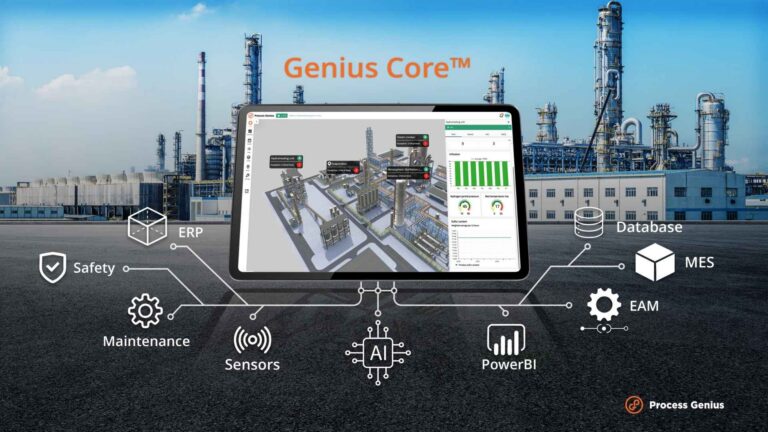
A digital twin is a digital counterpart of a real-world object, system, or process that is updated using data collected from its actual operating environment. It helps provide a comprehensive view of the asset’s current state, operation, and performance, while also making it possible to examine how different changes may affect its operation in the future.
A digital twin can represent, for example, an individual machine, a production line, a factory, a building, or a large-scale infrastructure system. It enables information distributed across different systems to be brought together, presented to users in an understandable format, and connected to the structures of the physical environment. In this way, a digital twin supports activities such as operational monitoring, forecasting, problem identification, and faster decision-making.
However, the value of a digital twin does not come solely from a three-dimensional model or an impressive visualization. What matters is that the virtual representation is connected to real-world data and serves the users’ actual needs. A data-driven digital twin can help an organization better understand its operations, improve performance, and develop processes based on data-driven insights.
In this article, we explain what a digital twin is, how digital twins are used in manufacturing and what opportunities they offer for data visualization, analysis, predictive maintenance, and operational optimization.
What does a digital twin mean?
A digital twin is a virtual representation of a real-world object or process. It can describe the structure, characteristics, operation, and condition of a physical asset, as well as changes in these aspects over time. The digital counterpart is updated with data collected from the asset and related systems so that it reflects the actual operating environment as accurately as possible.
The Digital Twin Consortium defines digital twins as virtual representations of real-world entities and processes that are synchronized with them at a specified frequency and fidelity.
This definition highlights two key characteristics of a digital twin: a virtual representation of a real-world asset and the continuous exchange of data between the two. A static 3D model alone is therefore not yet a digital twin. A digital model becomes a true digital twin when it is enriched with up-to-date data about the asset’s operation, conditions, and status.
Data can be collected from sources such as sensors, machines, automation systems, databases, and business applications. A digital twin brings this information together in a single operating environment and connects it to the relevant equipment, spaces, or stages of a process. This means users do not have to search across multiple separate systems for the information they need to understand the overall situation.
The way a digital twin is presented depends on its intended use. In some cases, clear metrics, reports, and two-dimensional views are sufficient for the user. In complex production and operating environments, information can be presented using a three-dimensional model, allowing users to see the physical location of the information and its relationship to the surrounding environment. What matters is not how visually impressive the presentation is, but whether the information is presented to the right user in a way that is easy to understand and supports decision-making.
A digital twin is also not a standardized, off-the-shelf product that is the same for every organization. Its data content, views, integrations, and functionality are built around the selected use case. For example, maintenance personnel need information about equipment condition and maintenance requirements, while production management monitors capacity, performance, and operational deviations.
A well-implemented digital twin serves as a shared information environment that brings together up-to-date data, the structure of the physical environment, and the tools users need. It helps transform information obtained from different systems and data generated by industrial IoT into an understandable situational overview and supports data-driven decision-making at different levels of the organization.

Digital Twin in Manufacturing
A digital twin in industry brings together the physical production or operational environment, the data collected from it, and the digital tools users need into a single integrated solution. It can be used to examine, for example, the operation of machines, production lines, factory sites, buildings, or infrastructure based on up-to-date information.
In industrial environments, information is often distributed across several different systems. Production, maintenance, automation, quality management, and business systems can all contain valuable information, but forming a comprehensive view is difficult if the user has to move from one system to another. A digital twin brings together information from different sources in a single view and links it to the relevant equipment, space, or stage of the process.
This makes it easier for users to understand what is happening in the physical environment right now, how operations have developed over time, and where potential deviations are occurring. At the same time, a digital twin can support performance monitoring, manufacturing costs management, and data-driven decision-making.
Digital Twin Supporting Production and Processes
In manufacturing industries, a digital twin can represent an individual machine, a production line, or an entire factory. Users can monitor equipment status, production progress, capacity, disruptions, and maintenance needs from a single operating environment.
In process industries, a digital twin can integrate information related to different stages of the production process and help identify how changes in one part of the process affect the overall operation. When information can be viewed in its proper context, identifying the causes of deviations and planning corrective actions becomes faster and more efficient.
A digital twin is a key component of the Industry 4.0 concept. It does not replace production or automation systems; instead, it consolidates the information they generate into a clear and understandable whole for the user. In this way, it can serve as a common interface between different systems.
Performance Monitoring
With a digital twin, performance can be monitored both in real time and over longer-term periods. Users can view key operational metrics such as production volumes, utilization rates, throughput times, energy consumption, disruptions, and other indicators that are critical to operations.
However, simply displaying metrics is not enough. The information must be linked to the correct equipment, process, or location so that users can interpret it quickly and effectively. For example, a digital twin can visually indicate where on a production line performance has declined or where energy consumption deviates from normal levels.
When performance data is viewed within the same environment as other operational information, it becomes easier for users to identify changes, compare different situations, and target improvement initiatives where they will have the greatest impact.
Optimizing Operational Costs
A real-time operational overview also helps organizations understand the factors that drive operating costs. A digital twin can bring together information related to energy consumption, maintenance activities, production downtime, material flows, and equipment utilization.
When cost-related factors can be linked directly to specific equipment and processes, organizations are better able to identify inefficiencies and assess the impact of improvement measures. The goal is not only to reduce costs, but to optimize operations as a whole while maintaining or improving productivity, reliability, and safety.
For example, a digital twin can help identify equipment whose energy consumption has increased, production stages that repeatedly experience delays, or maintenance targets whose issues cause unnecessary production interruptions.
Improving Workplace Safety
A digital twin can improve workplace safety by making risks, deviations, and safety-related information easier to identify and understand. Users can be presented with information such as hazardous areas, access routes, work permits, maintenance locations, and abnormal operating conditions directly within the digital environment.
Remote monitoring can also reduce the need for personnel to physically access difficult-to-reach or hazardous locations. Experts can assess the situation through the digital twin before beginning a task and plan the necessary actions in advance.
Digital twins can also support employee onboarding and work planning by helping users understand facility layouts, equipment locations, and safe operating procedures. This provides a clearer understanding of the work environment before entering the physical site.
Supporting Project Management
A digital twin can support project management, particularly in projects involving numerous stakeholders, technical systems, and continuously changing information. A shared digital environment enables project teams to work from the same up-to-date overview and reduces the fragmentation of information across files, systems, and communication channels.
Throughout different project phases, the digital twin can be used for design reviews, visualizing changes, monitoring progress, and documenting project handovers. When information is linked directly to the relevant location, equipment, or structure, project stakeholders can more easily understand the scope and impact of proposed changes.
A digital twin can continue to provide value even after project completion. Information gathered during the design and implementation phases can be integrated into the operation, maintenance, and continuous development of the facility. As a result, the digital information created during the project does not remain as a separate archive but continues to support the asset throughout its entire lifecycle.
Digital Twins Beyond Industry: Supporting Infrastructure Management
The use of digital twins is not limited to factories and production facilities. The same principles can also be applied to large-scale infrastructure assets such as telecommunications networks, wind farms, bridges, highways, and water distribution systems.
In these environments, a digital twin can combine information about asset condition, location, usage, maintenance history, and environmental conditions. This enables organizations to monitor extensive systems, identify anomalies, and plan maintenance activities more effectively.
For example, within a water distribution network, a digital twin can help visualize the network structure and the associated operational data. In a wind turbine, it can integrate data related to equipment performance, maintenance activities, and environmental conditions. For bridges and highways, digital twins can be used to monitor structural condition and maintenance requirements.
In both industry and infrastructure, the core purpose of a digital twin remains the same: to connect the physical asset, data collected from industrial IoT devices and other systems, and the tools required by users into a single, understandable, and actionable environment.

Data-Driven Digital Twin
The greatest value of a digital twin is based on data. Without up-to-date information, a digital twin is merely a static model that represents an asset as it existed at the time of design. When the digital model is continuously updated with data collected from various systems, it becomes a living representation of the asset’s actual operation.
A data-driven digital twin brings together information from multiple sources. Data may originate from industrial IoT sensors, automation systems, production management systems, maintenance systems, laboratory information systems, ERP solutions, or other business applications. Industrial communication standards such as OPC UA can be used to make machine and automation data available to the digital twin. The purpose of the digital twin is not to replace these systems, but to combine the information they generate into a single, easily understandable view.
One of the key advantages of a digital twin is that users do not need to know where the information is originally stored. Instead, the information is presented in the context where it is needed. Users can examine a piece of equipment, a production line, or a building and view all relevant information from a single interface, regardless of which underlying system the data comes from.
However, data quality is critical. A digital twin cannot improve poor-quality or incomplete data; its reliability depends on source-system data being accurate, up to date, properly connected, and readily usable. For this reason, data quality, data models, and system integrations are at least as important in digital twin design as the user interface and visualization capabilities. A Digital Twin ontology can provide an additional semantic structure by defining how assets, processes, systems, properties, and their relationships are organized and understood within the Digital Twin.
IT and OT Integration
In industrial organizations, information is often divided between two domains: Operational Technology (OT) and Information Technology (IT). OT systems control production processes and collect data from machines, equipment, and industrial operations, while IT systems manage areas such as production planning, maintenance, documentation, and business operations.
A digital twin acts as a bridge between these two worlds. By bringing IT and OT systems together within a common digital environment, users gain a comprehensive view of operations without the need to constantly switch between different systems.
This integration also enables the creation of new use cases. For example, a production disruption can be linked with maintenance records, energy consumption data, work orders, and production schedules. As a result, root causes can be identified more quickly, and decision-making can be based on a complete operational picture rather than on isolated observations.
Data Visualization
Industrial environments generate enormous amounts of data, but simply collecting information does not create value on its own. Users must be able to quickly understand what the data is telling them and how it relates to the physical environment.
A digital twin helps transform fragmented data into a clear operational overview. Information can be presented through dashboards, charts, maps, tables, or three-dimensional visualizations. The visualization method is always selected based on the intended use case—the goal is not impressive graphics, but the fastest and most effective understanding of information.
When data is linked to the correct location, asset, or process, users can immediately see where an anomaly exists and what potential impacts it may have. This reduces the time spent searching for information and facilitates collaboration across different teams and organizations.
Remote Monitoring
Because a digital twin is built on continuously updated data, assets and operations can be monitored without the need for a physical presence on site. Users can review production status, equipment condition, and process performance from virtually anywhere, provided the necessary information is available through secure connections.
In industrial environments, remote monitoring involves more than simply observing the current situation. It enables organizations to quickly detect anomalies, initiate appropriate actions, and provide experts with a shared view of operational conditions regardless of their physical location.
Remote monitoring is particularly valuable in distributed environments, such as organizations operating multiple production facilities, energy-sector assets, water distribution networks, and other forms of critical infrastructure. When all assets and operations can be accessed through a single digital environment, operational control becomes more efficient and response times can be significantly reduced.
Enabling Innovation
A data-driven digital twin is not only a solution for monitoring current operations. When data is collected consistently over time and analyzed from multiple perspectives, it creates new opportunities for improving processes and driving innovation.
Organizations can identify bottlenecks, compare the performance of different production lines, assess the impact of investments, and uncover new areas for improvement based on data-driven insights. At the same time, a digital twin provides a shared platform for implementing new ways of working, advanced analytics, and artificial intelligence solutions.
At its best, a digital twin serves as a tool for continuous improvement. It helps transform individual observations into long-term, data-driven decision-making and supports innovation while strengthening the organization’s competitiveness.
Digital Twins Enable Data-Driven Decision-Making
Organizations make countless decisions every day that affect production, maintenance, investments, safety, and resource utilization. The quality of these decisions depends on how easily the right information is available and how effectively different data sources come together to provide a unified view of operations.
A digital twin consolidates scattered information into a single operating environment and helps transform data into actionable insights for decision-making. Instead of reviewing individual reports or searching for information across multiple systems, users gain access to a real-time operational overview where information is presented in its proper context.
Data-driven decision-making reduces reliance on assumptions and helps organizations focus their efforts where they can have the greatest impact. At the same time, it enables faster responses to changing situations and provides a reliable foundation for justifying decisions with accurate and up-to-date information.
Faster Decision-Making
In many operating environments, speed is a critical competitive advantage. Production disruptions, equipment failures, or abnormal operating conditions can result in significant costs if identifying the root cause takes too long.
A digital twin accelerates decision-making by bringing all relevant information together into a single view. Users do not need to switch between multiple software applications or compare separate reports; instead, they can assess the situation through one unified interface.
When information is readily accessible, experts across the organization can develop a shared understanding of the situation more quickly. This improves collaboration between maintenance, production, engineering, and management teams while also speeding up the implementation of decisions and corrective actions.
Predictive Maintenance
One of the most significant applications of a digital twin is predictive maintenance. Instead of servicing equipment at fixed intervals or only after a failure has occurred, maintenance activities can be based on the actual condition and usage of the equipment.
A digital twin can combine data from multiple sources, including sensor measurements, operating history, fault reports, maintenance records, and environmental conditions. By analyzing this information, organizations can identify abnormal changes and trends that may indicate an emerging fault or an increasing need for maintenance.
The goal of predictive maintenance is not only to reduce unexpected equipment failures. It also helps improve asset reliability, minimize production downtime, optimize maintenance resources, and manage operating costs more effectively.
Analysis and Continuous Optimization
A digital twin supports continuous operational improvement by providing an up-to-date view of both current and historical performance. By comparing historical data with real-time conditions, organizations can identify trends, evaluate performance changes, and assess the impact of actions that have been taken.
Analysis can focus on areas such as production efficiency, energy consumption, material flows, maintenance effectiveness, or process bottlenecks. Industrial data analytics helps organizations turn this operational data into insights that can be used to identify improvement opportunities and optimize performance. A digital twin helps bring all of this information together in a single environment, making it significantly easier to build a comprehensive understanding of operations.
Optimization is not solely about reducing costs. Its objective is to achieve the right balance between productivity, quality, safety, reliability, and sustainability. When decisions are based on reliable data, organizations can pursue long-term improvements rather than simply reacting to individual issues as they arise.
Decision-Making Across the Organization
The benefits of a digital twin are not limited to a single group of users. Production teams require insight into process performance, maintenance teams need information about equipment condition, management needs visibility into business performance, and project teams must track the progress of ongoing initiatives.
When all users have access to the same up-to-date information, the organization can make decisions based on a consistent and shared understanding of the situation. This reduces information silos, improves collaboration between departments, and accelerates the flow of information throughout the organization.
At its best, a digital twin serves as a shared decision-making platform where the physical environment, data collected from various systems, and organizational expertise come together. This enables decisions to be made more quickly, more reliably, and with stronger justification based on facts and data.

Digital Twin as Part of Sustainable Development
Sustainable development is not only about reducing environmental impacts. In industry and infrastructure, it also means using resources efficiently, extending asset lifecycles, ensuring safe operations, and enabling better decision-making based on available information. Digital technologies and data-driven operations can therefore play an important role in supporting the green transition in industry.
A digital twin supports sustainability primarily by increasing operational transparency. When an organization has access to a real-time view of its equipment, processes, and performance, it becomes easier to identify opportunities for improvement, reduce waste, and direct investments to areas where they will deliver the greatest benefit.
For example, a digital twin can help optimize energy consumption, improve equipment utilization, reduce unnecessary maintenance activities, and extend the operational life of assets. It can also support sustainability initiatives by providing data that enables organizations to monitor performance, measure improvements, and make informed decisions about resource use.
From a sustainability perspective, a digital twin is therefore not just a single technology solution, but a tool that enables organizations to continuously improve their operations through data-driven insights and long-term planning.
More Efficient Resource Utilization
In many organizations, more energy, materials, and labor time are consumed than necessary because a comprehensive view of operations is not readily available.
A digital twin helps identify where resources are being used efficiently and where waste occurs. For example, energy consumption, material flows, equipment utilization, and production workloads can all be monitored within the same environment, allowing improvement initiatives to be targeted more accurately.
Even small, continuous improvements can, over time, reduce costs, lower environmental impacts, and strengthen an organization’s competitiveness.
Extending Asset Lifecycles
One of the key objectives of sustainable development is to maximize the use of existing equipment for as long as possible while maintaining safe and reliable operation.
A digital twin supports this goal by providing a real-time view of equipment usage, condition, and maintenance history. When predictive maintenance activities can be planned based on actual equipment condition and operational needs rather than fixed schedules, asset lifecycles can be extended and premature replacement investments can often be avoided.
At the same time, digital twins help reduce unexpected production interruptions and improve reliability across the entire operating environment, supporting both economic and environmental sustainability.
Safer and More Responsible Operations
A digital twin also supports safety and responsible operations. When users have access to up-to-date information about their operating environment, potential risks can be identified earlier and addressed before they lead to more serious issues.
A digital operating environment can assist with planning safe working procedures, monitoring deviations, preparing maintenance activities, and identifying high-risk areas. In addition, remote monitoring can reduce the need for personnel to physically access difficult-to-reach or hazardous locations.
Improving safety is also an important aspect of sustainability. Well-designed operating practices help reduce disruptions, lower the risk of accidents, and minimize unnecessary costs.
Readiness for Future Needs
Digitalization, automation, artificial intelligence, and advanced analytics are continuously transforming industrial operating environments. Organizations must be able to leverage increasing volumes of data and integrate new information sources into their daily operations.
A data-driven digital twin provides a flexible foundation for this evolution. When information is consolidated into a single digital environment, new systems, analytics tools, and AI solutions can be introduced gradually without the need to redesign the entire operating model.
In this way, a digital twin supports continuous organizational development, innovation, and long-term competitiveness.
A Digital Twin as an Investment in the Future
The implementation of a digital twin should not be viewed as a standalone software project. At its best, it represents a long-term investment in information management, operational improvement, and decision support.
When the physical operating environment, data collected from various systems, and the tools required by users are brought together into a unified solution, organizations can continuously improve their operations in an ever-changing business environment.
A digital twin helps connect people, data, and technology in a way that supports greater operational efficiency, more responsible use of resources, and sustainable development well into the future.
How Does Process Genius Implement a Digital Twin in Practice?
Every organization is different. Likewise, the objectives and use cases of a digital twin vary significantly depending on the industry, operational processes, existing systems, and user requirements. For this reason, an effective digital twin cannot be created from a one-size-fits-all template; it must be tailored to the specific operating environment of the organization. The practical process of defining the scope, connecting existing systems, structuring data, configuring the solution, and scaling it over time is covered in our guide to Digital Twin implementation.
Process Genius has developed its Genius Core™ technology specifically for this purpose. It enables data collected from different systems, sensors, and information sources to be integrated into a single digital operating environment where information is easily accessible and presented in a clear, understandable format.
Rather than requiring users to work across multiple separate software applications, Genius Core™ consolidates the necessary information into a single view. This helps create a real-time operational overview, supports analysis, and accelerates data-driven decision-making.
Built Around User Needs
The primary purpose of a digital twin is to support users in their day-to-day work. For this reason, Genius Core™ does not impose a predefined structure for what a digital twin should look like or what information it must contain.
Instead, the solution is built around the organization’s specific objectives. Users may need visibility into production operations, maintenance activities, buildings, infrastructure, energy consumption, or project progress. All of these can be integrated into the same digital environment.
The goal is simple: to provide the right information to the right user at the right time.
Integrating Existing Systems
In most organizations, valuable information already exists. The challenge is often that the data is scattered across multiple systems.
Genius Core™ is designed to integrate information from automation systems, IoT solutions, maintenance management systems, ERP platforms, documentation repositories, and other data sources into a single unified environment.
As a result, organizations do not need to replace their existing systems. Instead, the information generated by those systems can be utilized more effectively as part of a digital twin.
Scales with the Organization
A digital twin is not a finished product at the moment of deployment—it evolves alongside the organization’s needs.
Genius Core™ enables new data sources, functionalities, and use cases to be added incrementally. An organization can begin with a single production line, building, or process and later expand the digital twin to encompass its entire operating environment.
This approach ensures that the investment delivers value from the very first implementation while continuing to grow alongside the business.
A Digital Twin That Supports Decision-Making
The goal of Process Genius is not simply to create visually impressive digital models. The objective is to deliver a solution that helps users better understand their operations and make better-informed decisions.
When real-world data, business systems, and the tools required by users are brought together within a single environment, the digital twin becomes a practical tool that supports daily operations.
Whether the focus is production monitoring, maintenance management, infrastructure oversight, or project leadership, the primary role of a digital twin is to help organizations make more effective use of their data.
Would You Like to See How a Digital Twin Works in Practice?
Every organization has unique requirements. We would be happy to discuss what kind of digital twin would best support your specific operating environment and business objectives.
→ Explore the Genius Core™ solution
→ Contact the experts at Process Genius
FAQs
What Does a Digital Twin Mean?
A digital twin is a digital representation of a physical asset, process, or system that utilizes both real-time and historical data. It enables organizations to monitor operations, analyze performance, identify anomalies, and support decision-making. Unlike a static 3D model, a digital twin is continuously updated using information collected from various data sources.
How Does a Digital Twin Work?
A digital twin integrates data from sources such as sensors, automation systems, IoT devices, ERP platforms, maintenance systems, and other information systems. This data is presented within a unified digital environment where users can monitor the current state of an asset, analyze historical trends, and leverage predictive insights to support decision-making.
Is a Digital Twin the Same as a 3D Model?
No. A 3D model represents the structure or appearance of an asset, but it typically does not include continuously updated operational data. A digital twin combines a digital model with real-time information from the physical asset, enabling monitoring, analysis, and optimization of operations.
How Does a Digital Twin Differ from a Simulation?
A simulation is generally based on predefined inputs and assumptions used to evaluate different scenarios. A digital twin, on the other hand, incorporates real-time data from the physical asset. While simulation can be a component of a digital twin, a digital twin provides a continuously updated view of the actual operating environment.
What Are the Benefits of a Digital Twin in Industry?
In industrial environments, a digital twin helps organizations monitor production, optimize processes, support predictive maintenance, and improve resource utilization. By bringing information from different systems into a single view, organizations can identify improvement opportunities more quickly and make decisions based on current, accurate data.
What Types of Data Does a Digital Twin Use?
A digital twin can utilize a wide range of data sources, including:
- Sensor data
- IoT device measurements
- Automation system data
- Maintenance records and history
- Manufacturing execution system (MES) data
- ERP information
- Energy consumption data
- Technical documentation
- Other operational and business system data
The higher the quality and accuracy of the data, the greater the value the digital twin can deliver.
Can a Digital Twin Be Integrated with Existing Systems?
Yes. Digital twins are typically designed to leverage existing systems rather than replace them. They can integrate information from IoT platforms, automation systems, ERP, MES, SCADA, maintenance management systems, and other data sources into a unified environment.
How Does a Digital Twin Support Predictive Maintenance?
A digital twin consolidates condition-related information such as sensor measurements, operating history, and maintenance records. This information can be used to identify anomalies before actual failures occur, schedule maintenance activities at the right time, and reduce unexpected production downtime.
Where Can Digital Twins Be Used?
Digital twins are used across a wide range of industries and applications, including:
- Manufacturing
- Process industries
- Energy and utilities
- Facilities and property management
- Construction
- Infrastructure management, such as bridges, road networks, and water systems
As new data sources and analytics technologies continue to evolve, the range of applications for digital twins continues to expand.
Who Can Benefit from a Digital Twin?
A digital twin is suitable for organizations that want to make better use of data to improve their operations. It can support:
- Production management
- Maintenance and asset management
- Project management
- Building and facility operations
- Infrastructure management
- Energy system monitoring
- Strategic and operational decision-making
By providing a unified, data-driven view of operations, a digital twin helps organizations improve efficiency, enhance visibility, and make more informed decisions.