
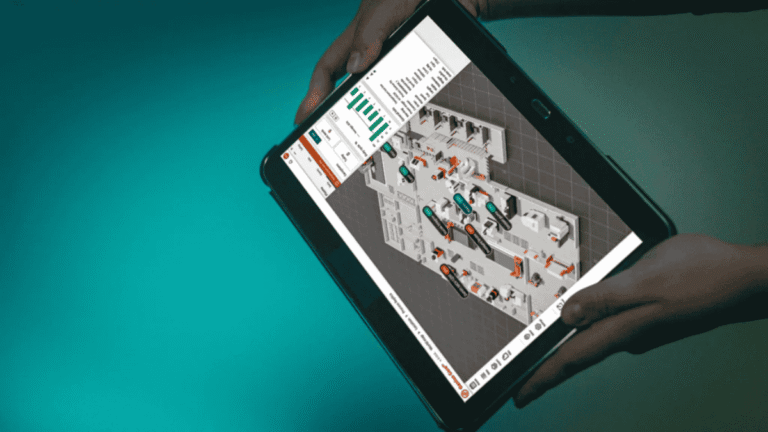
What is a Digital Twin ontology?
A Digital Twin ontology is a structured way of defining and organizing the assets, systems, processes, data, and relationships represented within a Digital Twin. It provides a common framework for describing what different pieces of information mean and how they relate to one another.
In an industrial environment, data can come from many different sources, including machines, sensors, automation systems, IoT devices, ERP and MES platforms, maintenance systems, and databases. A Digital Twin ontology gives this information context by defining relationships between physical assets, operational processes, locations, systems, and other relevant entities.
For example, instead of treating a machine, its sensor data, maintenance history, production status, and location as separate pieces of information, an ontology can define how they are connected. The Digital Twin can then represent these relationships in a consistent structure that is easier for people and systems to understand, navigate, and analyze.
This common structure also supports semantic interoperability. Different systems may use different data formats, terminology, and structures, but an ontology helps establish shared meanings and relationships between their information. Industrial communication technologies such as OPC UA can complement this approach by enabling data exchange between machines, automation systems, and other industrial applications.
Digital Twin vs. Digital Twin ontology
A Digital Twin and a Digital Twin ontology are closely related, but they are not the same thing.
A Digital Twin is a virtual representation of a physical asset, system, process, or operational environment. It brings relevant information together so that users can monitor conditions, understand performance, analyze data, and support operational decision-making.
A Digital Twin ontology defines how the information behind that Digital Twin is structured and connected. It describes the entities within the environment, their properties, and the relationships between them. In other words, the Digital Twin provides the virtual representation, while the ontology provides part of the semantic structure that gives its data context and meaning.
Consider a manufacturing plant. The Digital Twin may represent the factory, production lines, machines, processes, and operational data in a unified digital environment. The ontology can define that a particular machine belongs to a specific production line, contains certain components, receives data from particular sensors, performs a particular process, and is associated with maintenance records or production information.
The distinction becomes increasingly important as Digital Twins grow and connect information from more assets and systems. A well-defined ontology helps keep these relationships consistent, making industrial information easier to integrate, search, interpret, and scale.

How does Digital Twin ontology work?
Digital Twin ontology works by creating a structured model of the things that exist within a physical or operational environment and defining how they relate to each other. Instead of bringing data from different sources into a Digital Twin as isolated information, ontology provides the context needed to understand what that data represents and where it belongs.
In practice, this means identifying relevant entities, defining their properties, establishing relationships between them, and organizing those relationships into a structure that can be consistently understood across the Digital Twin.
Concepts, entities and properties
The foundation of a Digital Twin ontology consists of the concepts and entities that describe the environment being represented.
In manufacturing, entities might include factories, production lines, machines, components, sensors, products, processes, or maintenance activities. Each entity can then have properties that describe it. A machine, for example, might have properties such as its equipment type, operating status, temperature, production capacity, or maintenance condition.
These definitions create a consistent model for organizing information from different sources. Instead of simply displaying individual data points, the Digital Twin can associate them with the assets, processes, and operational context they describe.
Relationships and hierarchies
The real value of an ontology comes from defining how entities are connected.
A manufacturing site, for example, may contain several production lines. A production line contains machines, machines contain components, and components may be monitored by sensors. At the same time, those machines can be connected to production processes, maintenance activities, work orders, and other operational information.
These relationships can form hierarchies such as:
Factory → Production line → Machine → Component → Sensor
But Digital Twin ontology is not limited to physical hierarchies. It can also describe functional and operational relationships, such as which process a machine performs, which sensor monitors a component, or which maintenance activity relates to a particular asset.
By connecting information through these relationships, a Digital Twin can provide a more contextualized view of an industrial environment rather than presenting information as disconnected data points.
Semantic interoperability and shared meaning
Industrial organizations often use multiple systems that describe the same assets and operations in different ways. Information may be distributed across automation systems, IoT platforms, maintenance applications, production systems, business systems, and databases.
Digital Twin ontology helps establish shared meaning between this information by defining common concepts and relationships. This is known as semantic interoperability: different systems can exchange information while preserving an understanding of what that information represents.
For example, two systems may identify the same machine using different names, identifiers, or data structures. By mapping their information to a common ontology, the Digital Twin can establish that both sources refer to the same physical asset and place their data within the correct operational context.
This becomes especially valuable when a Digital Twin integrates information from many industrial systems. Technologies such as Industrial IoT can provide connectivity and operational data, while the ontology helps organize that information into meaningful relationships that can be used for monitoring and analytics.
Digital Twin ontology in manufacturing
In manufacturing, a Digital Twin ontology provides a structured way to represent the physical, operational, and informational elements of a production environment. It defines not only which assets and processes exist, but also how they are connected.
A simple physical hierarchy might look like this:
Factory → Production line → Machine → Component → Sensor
This structure helps the Digital Twin understand where each asset belongs. However, manufacturing operations involve much more than physical equipment. The same machine can also be connected to production and maintenance information:
Machine → Production process → Work order → Maintenance activity → KPI
Together, these relationships create a more complete operational context. Instead of viewing a machine only as an isolated asset, users can understand where it is located, what process it supports, which sensors monitor it, what work orders are associated with it, and how its condition or performance relates to operational KPIs.
This is one of the important roles of ontology in a Digital Twin in manufacturing: creating meaningful relationships between information that would otherwise remain distributed across different systems and data sources.
Connecting data from different industrial systems
Manufacturing data rarely comes from a single system. ERP, MES, SCADA, IoT platforms, automation systems, maintenance applications, databases, and other industrial solutions can all contain information relevant to the same production environment.
Each system, however, has a different purpose. ERP and MES systems, for example, may contain business, production, planning, and operational information, while SCADA and automation systems provide information closer to machines and industrial processes. IoT devices and sensors can add real-time condition and performance data.
A Digital Twin ontology helps connect these different sources by mapping their information to common assets, processes, locations, and concepts. A machine represented in the Digital Twin can therefore be associated with its real-time sensor measurements, production status, maintenance information, work orders, and other relevant operational data even when that information originates from separate systems.
Connectivity technologies such as OPC UA can support the exchange of industrial data between equipment and software systems. The ontology adds another layer by defining the context and relationships needed to understand how that information fits into the wider operational environment.
The result is not simply more connected data. It is more contextualized data: information organized around the relationships between assets, processes, systems, and operations. This provides a stronger foundation for monitoring, analysis, and operational decision-making.

Taxonomy and classification in Digital Twin ontology
Taxonomy and classification help organize the concepts represented within a Digital Twin ontology. They provide logical ways to group assets, processes, functions, and applications so that complex industrial environments are easier to structure and navigate.
A taxonomy is not the same as an ontology. A taxonomy primarily organizes concepts into categories and hierarchies, while an ontology also defines their properties, meaning, and relationships. In practice, taxonomies can therefore form an important part of a broader Digital Twin ontology.
Depending on the purpose of the Digital Twin, information can be classified from several different perspectives.
Functional taxonomy
A functional taxonomy organizes elements according to what they do within the Digital Twin or industrial environment.
For example, functions may include data acquisition, data processing, visualization, analytics, simulation, monitoring, and control. Industrial assets can also be classified according to the functions they perform within a production process.
This type of classification is useful when a Digital Twin brings multiple operational capabilities into the same environment. Instead of organizing information only around physical equipment, users can also understand how different assets, systems, and data support particular functions.
Domain-specific taxonomy
A domain-specific taxonomy organizes concepts according to the industry or operational domain in which the Digital Twin is used.
Manufacturing, energy, transportation, healthcare, and smart cities, for example, involve different assets, processes, terminology, and operational requirements. Their Digital Twin ontologies therefore need to represent different domain-specific concepts.
Within manufacturing, the taxonomy might include concepts such as production lines, machines, equipment types, production processes, quality metrics, materials, and maintenance activities.
Domain-specific classification helps ensure that the ontology reflects the terminology and relationships that are meaningful within the actual operating environment rather than relying on a generic data structure.
Application-specific taxonomy
An application-specific taxonomy organizes information according to the use cases the Digital Twin needs to support.
In manufacturing, these applications could include predictive maintenance, production optimization, asset management, quality monitoring, energy management, or supply chain visibility.
The same industrial asset may participate in several of these applications. A machine, for example, can simultaneously contribute data to production monitoring, maintenance planning, and energy analysis.
Organizing information around applications helps connect the underlying ontology to practical operational objectives. It also makes it easier to identify which assets, data, and relationships are required for a particular Digital Twin use case.
Hierarchical taxonomy
A hierarchical taxonomy organizes concepts from broader categories into increasingly specific levels.
For example, an industrial Digital Twin could include a structure such as:
Asset management → Equipment health monitoring → Machine condition → Sensor measurement
Another hierarchy could describe the physical production environment:
Factory → Production area → Production line → Machine → Component
Hierarchical classification makes complex environments easier to navigate and provides a logical structure for organizing large numbers of assets and data points.
However, an ontology goes beyond these parent-child relationships. A machine can belong to one physical hierarchy while also being connected to a production process, maintenance activity, work order, KPI, or other operational concept elsewhere in the Digital Twin.
Combining classification with these broader relationships allows a Digital Twin ontology to represent an industrial environment as an interconnected system rather than simply as a collection of asset trees and categories.

Why is ontology important for Digital Twins?
The value of a Digital Twin depends not only on how much data it can access, but also on how well that data is organized and understood. As industrial environments become more connected, Digital Twins may need to combine information from hundreds or thousands of assets, sensors, processes, and software systems.
Without a consistent structure, adding more data can also add more complexity. Digital Twin ontology helps address this challenge by defining how information is classified, connected, and interpreted across the digital environment.
Breaking down industrial data silos
Industrial information is often distributed across multiple systems and departments. Production data may be stored in an MES, business information in an ERP system, equipment conditions in automation or IoT platforms, and maintenance information in separate asset management applications.
A Digital Twin ontology helps bring context to these fragmented sources by connecting their information to common assets, processes, locations, and operational concepts.
For example, maintenance history, production status, sensor measurements, and performance data may all relate to the same machine even though they originate from different systems. By establishing that relationship, the Digital Twin can provide a more unified view of the asset and its operational context.
This does not eliminate the original systems or replace their specialized functions. Instead, ontology provides a structured way to connect and interpret relevant information across them.
Improving interoperability
Connecting systems technically is only part of industrial interoperability. Different applications may use different identifiers, terminology, data structures, and definitions for the same physical asset or operational concept.
Ontology helps create a shared semantic layer by defining common concepts and relationships. This allows information from different sources to be interpreted within the same context, even when the underlying systems organize their data differently.
The result is stronger semantic interoperability: systems and users can understand not only the data being exchanged, but also what that data represents and how it relates to the wider industrial environment.
This is particularly valuable in connected manufacturing, where machines, automation systems, industrial software, and business applications increasingly need to work with information across traditional system boundaries.
Making Digital Twins scalable
A small Digital Twin may initially represent a limited number of assets and data sources. As its scope expands, however, it may need to cover additional machines, production lines, facilities, systems, processes, and use cases.
Without a consistent structure, each expansion can require new point-to-point mappings and custom ways of organizing information. This can make the Digital Twin increasingly difficult to maintain.
An ontology provides reusable concepts, relationships, and classification principles that can be applied as the Digital Twin grows. New assets and data sources can be mapped into an existing structure instead of being treated as entirely separate integrations.
This makes it easier to extend a Digital Twin from an individual machine or production line toward larger operational environments while maintaining consistent relationships and meaning.
Improving analytics and decision-making
Analytics becomes more useful when data includes operational context.
A temperature measurement alone provides limited information. Its meaning becomes much clearer when the Digital Twin understands which sensor produced it, which component the sensor monitors, which machine contains that component, what process the machine is performing, and how the measurement relates to other operational information.
Ontology provides these relationships and helps transform isolated data points into contextualized information.
This creates a stronger foundation for industrial data analytics. Data can be analyzed in relation to assets, processes, maintenance activities, production conditions, and other relevant factors rather than as disconnected values from individual systems.
For decision-makers, the benefit is a more coherent operational view. Instead of manually combining information from multiple applications, users can explore connected data within its relevant context and identify relationships that support monitoring, troubleshooting, optimization, and operational decisions.
Digital Twin ontology and Industry 4.0
As industrial environments become more connected, Digital Twins need to work with growing volumes of information from machines, sensors, automation systems, software platforms, and other data sources. This makes consistent data structures and shared meanings increasingly important.
Within Industry 4.0, Digital Twin ontology can provide a semantic foundation for connecting information across these environments. By defining common concepts and relationships, ontology helps different systems contribute data to a Digital Twin without losing the context needed to understand what that information represents.
Interoperability and scalability are particularly important as Digital Twins expand from individual assets to production lines, factories, and more complex industrial environments. A consistent ontology makes it easier to incorporate new assets, systems, and data sources while maintaining a common structure.
Security also needs to be considered as these environments become increasingly connected. Ontology does not provide cybersecurity by itself, but a clearly structured Digital Twin can support better understanding of which assets, systems, data sources, and relationships exist within the environment. Security controls and access policies still need to be implemented through the appropriate industrial and IT security architecture.
As Industry 4.0 continues to evolve, the role of Digital Twin ontology is therefore less about creating more data and more about making increasingly connected industrial information understandable, interoperable, and scalable.

How to build a Digital Twin ontology
Building a Digital Twin ontology starts with understanding what the Digital Twin needs to represent and what operational purpose it needs to serve. The goal is not to model every possible piece of information from the beginning, but to create a consistent structure that can evolve as new assets, systems, and use cases are added.
A practical approach can include the following steps:
- Define the domain and use case. Start by defining the environment the Digital Twin will represent and the problems it needs to help solve. The required ontology for a production line, for example, may differ from one designed to represent an entire manufacturing site.
- Identify the relevant assets, systems, and processes. Determine which machines, components, sensors, production processes, locations, software systems, and other operational elements need to be represented.
- Define entities and their properties. Establish the main concepts within the ontology and determine which properties describe them. A machine might include information about its type, location, operational status, capacity, or condition.
- Map relationships and hierarchies. Define how the entities relate to each other. This can include physical relationships, such as a component belonging to a machine, as well as operational relationships between machines, processes, work orders, maintenance activities, and KPIs.
- Connect relevant data sources. Identify where the information comes from and map it to the appropriate entities and relationships. Depending on the environment, these sources may include automation systems, IoT platforms, ERP, MES, maintenance applications, databases, and other industrial systems.
- Establish common terminology. Define consistent names and meanings for important concepts. This is particularly important when different systems or departments use different terminology for the same assets, processes, or operational information.
- Validate the ontology against operational use cases. Test whether the structure actually supports the questions and workflows the Digital Twin needs to address. Users should be able to navigate from assets to relevant processes, data, and operational information without having to understand how each underlying source system is structured.
- Extend the ontology as the Digital Twin evolves. A Digital Twin ontology should not be treated as a static model. New assets, systems, data sources, and use cases can be incorporated over time while maintaining the established concepts and relationships.
The ontology is therefore one part of a broader Digital Twin implementation. Connectivity, data integration, visualization, analytics, user requirements, and operational processes also need to be considered when turning the underlying information model into a Digital Twin that delivers practical value.
Starting with a clearly defined scope and expanding the ontology iteratively can help avoid unnecessary complexity while creating a structure that is easier to maintain and scale.
FAQs
What is digital twin ontology?
Digital twin ontology is a structured framework that defines how assets, systems, processes, and data are organized and connected within a digital twin environment. It helps standardize relationships between industrial data sources, making digital twins more scalable, searchable, and easier to manage.
Why is ontology important in digital twins?
Ontology is important because it creates a common data structure across systems, devices, and operations. This improves data consistency, simplifies integration, and enables better visibility and analytics across industrial environments.
What is the difference between a Digital Twin and a Digital Twin ontology?
A Digital Twin is a virtual representation of a physical asset, process, system, or operational environment. A Digital Twin ontology defines how the concepts, properties, and relationships behind that representation are structured. The Digital Twin provides the virtual environment, while the ontology helps give its information context and meaning.
What is the difference between ontology and taxonomy in a Digital Twin?
A taxonomy primarily classifies concepts into categories and hierarchies. An ontology goes further by defining properties, meanings, and relationships between those concepts. Taxonomies can therefore be used as part of a broader Digital Twin ontology.
Is a Digital Twin ontology the same as a knowledge graph?
No. An ontology defines the concepts, properties, relationships, and rules used to describe a domain. A knowledge graph represents specific entities and their relationships as connected data. An ontology can provide the semantic structure used to organize and interpret information within a knowledge graph, but the two concepts are not interchangeable.
How does Digital Twin ontology improve industrial data management?
Digital Twin ontology connects information to common assets, processes, locations, and operational concepts. For example, data from production, maintenance, automation, and business systems can be associated with the same machine or process. This helps turn fragmented industrial data into contextualized information that is easier to navigate, analyze, and use.
Can a Digital Twin ontology connect data from ERP, MES, SCADA, and IoT systems?
Yes. A Digital Twin ontology can define common entities and relationships to help contextualize information originating from ERP, MES, SCADA, IoT platforms, automation systems, databases, and other industrial data sources. The ontology does not replace these systems; it provides a structure for understanding how relevant information from them relates within the Digital Twin.
Does every Digital Twin need an ontology?
Not every Digital Twin requires a complex or formally defined ontology. A relatively simple Digital Twin may work with a limited information model and a small number of assets and data sources. As the Digital Twin expands across more systems, assets, processes, and use cases, however, a consistent ontology can become increasingly valuable for maintaining shared meaning, interoperability, and scalability.