Modern industrial operations generate continuous streams of data from machines, sensors, production systems, buildings, and other connected assets. But accessing this information often requires people to be physically present or switch between multiple systems to understand what is happening.
Remote monitoring allows organizations to observe equipment, processes, and operating conditions from another location. By collecting and transmitting operational data to a centralized monitoring system, teams can track performance, identify unusual conditions, and respond to problems without always being on site.
This is particularly valuable for manufacturers and other industrial organizations managing large facilities, distributed equipment, or assets across multiple locations. Instead of relying only on periodic inspections, teams can maintain continuous visibility into important operating conditions.
Remote monitoring can also provide the data foundation for more advanced applications such as automated alerts, predictive maintenance, industrial data analytics, and Digital Twins.
What is Remote Monitoring?
Remote monitoring is the process of collecting data from equipment, assets, processes, or facilities and making that information available to users from another location.
In industrial environments, data is typically collected from sensors, machines, control systems, and other connected devices. It is then transmitted through industrial networks or internet-connected systems to software where users can monitor operating conditions, performance, and changes over time.
For example, a maintenance team could remotely monitor the temperature and vibration of a machine. If either measurement begins moving outside its normal operating range, the monitoring system can alert the team so they can investigate before the problem develops into a more serious failure.
Remote monitoring can be used to track many different conditions, including equipment status, temperature, pressure, vibration, energy consumption, production output, environmental conditions, and other operational parameters.
The purpose is not simply to view data remotely. Effective remote monitoring gives the right people timely information about the condition and performance of physical operations, helping them recognize problems and make informed decisions without needing to be physically present at every asset or facility.

How does remote monitoring work?
Remote monitoring works by collecting operational data from physical equipment or systems, transmitting that data to a monitoring platform, and presenting relevant information to users who may be located elsewhere.
Although the exact setup varies between facilities and applications, most industrial remote monitoring systems follow the same basic process.
1. Collect data from equipment and systems
The process begins with the equipment, assets, or environment being monitored. Sensors and existing control systems can collect measurements such as temperature, pressure, vibration, energy consumption, operating status, production output, and other relevant parameters.
Modern Industrial IoT technologies make it possible to connect a wide range of physical assets and continuously collect operational data from them.
2. Transmit the data
Collected data must then be transferred from the equipment to the system where it will be processed and monitored.
Depending on the environment, this may involve industrial networks, gateways, wired or wireless connections, or internet-based communication. Existing automation and control systems can also provide data without requiring every asset to be equipped with entirely new monitoring hardware.
3. Centralize and process the data
Once transmitted, data from different sources can be brought together in a centralized system. This gives users a more consistent view of equipment and operations instead of requiring them to check individual machines or disconnected systems separately.
The data can also be organized, filtered, and contextualized so users see information that is relevant to the assets or processes they are responsible for.
4. Monitor conditions and detect changes
Remote monitoring software continuously presents current conditions and can compare measurements against predefined limits, operating ranges, or expected behavior.
For example, a rising machine temperature, unusual vibration level, unexpected energy consumption, or change in production performance can indicate that something requires attention.
Monitoring these changes over time helps teams identify developing problems earlier than periodic manual inspections alone.
5. Alert users and support action
When predefined conditions are met, the monitoring system can notify the appropriate people. Alerts may indicate equipment problems, abnormal operating conditions, performance changes, or other situations requiring investigation.
Users can then examine the available information remotely, determine the appropriate response, and decide whether intervention on site is necessary.
The result is a continuous flow from physical operations to digital visibility: data is collected, transmitted, interpreted, and presented to the people who need it. This allows organizations to respond to changing conditions without requiring constant physical supervision of every asset.

What data can be monitored remotely?
Remote monitoring can be applied to many types of operational data. What an organization chooses to monitor depends on its equipment, processes, facilities, and the decisions teams need to make.
In industrial environments, the most useful data typically falls into several categories.
Equipment and condition data
Equipment data helps teams understand the current condition and operating state of physical assets. Common measurements include temperature, vibration, pressure, speed, runtime, operating status, and fault signals.
Tracking these measurements over time can help identify changes in equipment behavior and indicate when an asset may require closer inspection.
Production and process data
Remote monitoring can provide visibility into how production processes are performing. This may include production output, cycle times, process parameters, machine states, throughput, and other operational KPIs.
This information helps production teams see whether processes are operating as expected and identify changes that may affect performance.
Energy and environmental data
Organizations can remotely monitor electricity, water, compressed air, fuel, and other resource consumption. Environmental conditions such as temperature, humidity, air quality, and emissions can also be monitored where relevant.
Bringing this information into the same monitoring environment can make unusual consumption patterns or changing conditions easier to identify.
Maintenance and asset data
Maintenance teams can monitor equipment runtime, service status, alarms, fault history, and condition-related measurements. Combining current operating information with maintenance data provides a clearer picture of which assets may require attention.
This can help teams prioritize inspections and maintenance activities based on actual equipment conditions rather than relying only on fixed schedules.
Building and facility data
Remote monitoring is also useful beyond production equipment. Facilities can monitor HVAC systems, indoor conditions, energy use, utilities, access systems, and other building infrastructure.
For organizations operating multiple buildings or sites, centralized monitoring provides visibility across locations without requiring personnel to continuously inspect each facility in person.

Remote monitoring use cases
Remote monitoring can support many operational activities, from tracking individual machines to overseeing equipment across multiple facilities. The most valuable applications are usually those where continuous visibility helps teams identify problems, coordinate work, or reduce the need for manual inspections.
Manufacturing and industrial equipment
Manufacturers can remotely monitor machines, production lines, and other critical equipment to understand operating status and performance.
Through industrial monitoring, teams can track relevant conditions from a centralized view instead of relying only on physical inspections or information from individual control systems. This is especially useful in large facilities where equipment is distributed across different production areas.
A practical example is Flowrox’s remote equipment monitoring solution, where sensor data from industrial equipment is brought into a visual environment that allows equipment to be monitored remotely and supports maintenance and operational decision-making.
Predictive maintenance and equipment condition
Condition data such as vibration, temperature, pressure, and runtime can help maintenance teams identify changes in equipment behavior.
Rather than discovering every problem during scheduled inspections or after a failure, teams can use remotely collected condition data to investigate developing issues and support predictive maintenance strategies.
For example, Pekotek uses real-time condition monitoring to support predictive maintenance, helping users track critical equipment conditions and better understand when maintenance is required.
Production and process monitoring
Production teams can remotely track output, process parameters, machine states, cycle times, and other operational KPIs.
This makes it easier to identify production interruptions, unusual process conditions, and performance changes as they happen. Supervisors can also maintain visibility across several production areas without continuously moving between individual machines or control rooms.
At Snellman, real-time production monitoring provides visibility into production lines and processes, helping operators identify deviations and react more quickly when conditions change.
Energy and resource monitoring
Energy and resource consumption can be monitored across machines, production lines, buildings, or entire sites.
Tracking electricity, water, compressed air, fuel, and other resources helps organizations identify unusual consumption patterns and understand where resources are being used. Remote access is particularly useful when consumption needs to be compared across multiple areas or locations.
Distributed facilities and remote assets
Remote monitoring becomes especially valuable when equipment and facilities are geographically distributed.
Organizations can maintain visibility into remote production sites, warehouses, technical facilities, utilities, or other assets from a central location. Teams can review current conditions and alerts before deciding whether an on-site visit is required.
The Elisa smart building solution provides a practical example of this approach. Sensor and facility data is used across multiple properties to provide up-to-date visibility into operating conditions, space utilization, and available work and parking spaces.
This type of centralized visibility can reduce unnecessary site visits while helping teams manage facilities and assets across multiple locations more effectively.
Benefits of remote monitoring
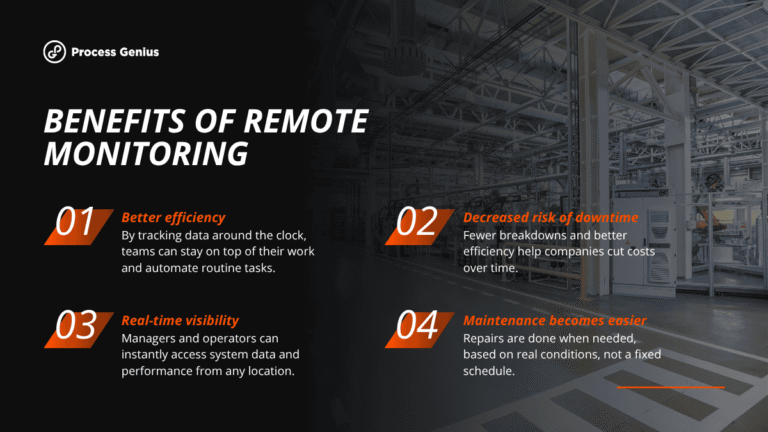
The main advantage of remote monitoring is continuous access to operational information without requiring people to be physically present at every machine, asset, or facility. This can improve how quickly teams understand changing conditions and respond to problems.
Real-time operational visibility
Remote monitoring gives teams access to current equipment, process, and facility data from wherever they are authorized to access the system.
Instead of waiting for manual inspections or reports, operators, maintenance teams, and managers can see what is happening across relevant assets and locations. This creates a more consistent operational picture and helps teams focus attention where it is needed.
Faster response to problems
When abnormal conditions or equipment issues occur, remote monitoring can make them visible immediately through dashboards, notifications, or alerts.
Teams can investigate the available data before deciding what action is required. Earlier awareness can prevent relatively small issues from developing unnoticed and helps the right people respond more quickly.
Reduced downtime
Continuous monitoring can reveal changes in equipment condition or performance before they result in a complete failure.
By identifying warning signs earlier, maintenance teams have more time to investigate problems and plan interventions. This can help organizations reduce unplanned downtime and avoid some of the production losses associated with unexpected equipment failures.
More efficient maintenance
Remote access to equipment condition and operating data helps maintenance teams determine which assets require attention and which continue to operate normally.
This can reduce unnecessary inspections and make it easier to prioritize maintenance based on actual operating conditions. Specialists can also assess some problems remotely before technicians are sent to the equipment.
Lower operational costs
Remote monitoring can reduce costs in several ways, including fewer unnecessary site visits, more efficient maintenance, earlier fault detection, and better use of personnel and resources.
When combined with broader efforts to reduce operational costs, monitoring data can also help organizations identify inefficient equipment, excessive resource consumption, and recurring operational problems.
Better management of distributed operations
For organizations with multiple facilities or geographically distributed assets, remote monitoring creates a centralized way to maintain operational visibility.
Teams can compare conditions across locations, support local personnel remotely, and share specialist expertise without requiring the same people to be physically present at every site. This becomes increasingly valuable as the number of monitored assets and locations grows.
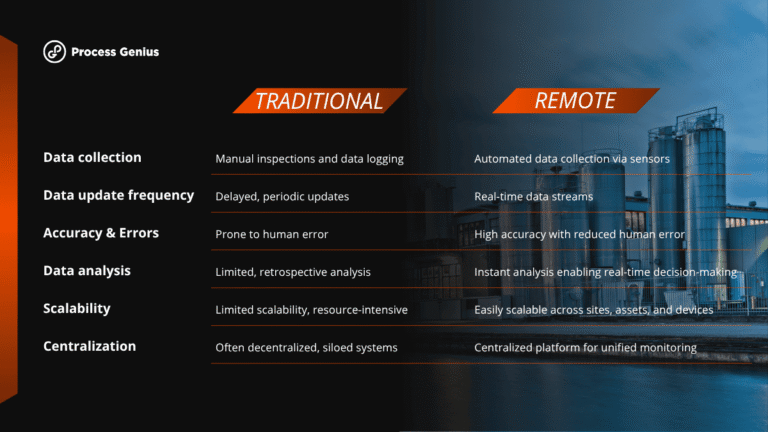
Remote monitoring vs. traditional monitoring
Traditional monitoring often depends on people being physically present to inspect equipment, read instruments, check control systems, or identify visible signs of problems. These inspections remain important, but they provide information only at specific points in time.
Remote monitoring extends this visibility by continuously collecting operational data and making it available to authorized users from another location.
For example, a technician performing a manual inspection might record a machine’s temperature once during a shift. A remote monitoring system can track the same measurement continuously and show how it changes throughout operation. If the temperature exceeds a defined threshold, the system can alert the appropriate team.
Remote monitoring also makes it easier to oversee large numbers of assets or multiple locations from a centralized environment. Instead of traveling between equipment or facilities simply to check current conditions, teams can use remote data to determine where attention is required.
However, remote monitoring does not eliminate the need for people on site. Physical inspections, maintenance work, repairs, and operational expertise remain essential. The difference is that remote monitoring gives teams more continuous information to help decide when and where intervention is needed.
In practice, the two approaches work best together: remote monitoring provides continuous visibility, while on-site personnel provide the physical inspection, expertise, and intervention that digital systems cannot replace.

Technologies used for remote monitoring
Remote monitoring depends on several technologies working together. Sensors and connected equipment generate data, communication technologies move it between systems, and software turns that data into information people can use.
The exact technology stack varies depending on the equipment, existing infrastructure, monitoring requirements, and scale of the operation.
Sensors and Industrial IoT
Sensors provide many of the measurements used in remote monitoring, including temperature, vibration, pressure, humidity, energy consumption, and other operating conditions.
Industrial IoT technologies connect these sensors and other physical assets to digital systems so data can be collected continuously. Existing machines and automation systems can also provide valuable operational data, meaning remote monitoring does not always require replacing existing equipment.
Industrial connectivity and OPC UA
Remote monitoring also requires reliable communication between equipment, control systems, gateways, and monitoring software.
Industrial communication standards such as OPC UA help different machines and systems exchange operational data in a standardized way. This is particularly valuable in industrial environments where equipment from different manufacturers and generations must contribute data to the same monitoring environment.
Edge and cloud computing
Depending on the application, monitoring data may be processed locally, in the cloud, or through a combination of both.
Edge computing allows data to be processed close to the equipment, which can be useful when fast responses or local processing are required. Cloud platforms can provide centralized access, storage, and scalability across multiple assets and locations.
The appropriate architecture depends on factors such as connectivity, latency, security requirements, data volumes, and how the information will be used.
Remote monitoring software
Remote monitoring software provides the interface through which users view equipment status, operating conditions, trends, KPIs, and alerts.
Dashboards can present information from multiple assets or systems in one place, while notifications help users identify conditions requiring attention. Effective monitoring software should make important information easy to understand rather than simply displaying every available data point.
Industrial data analytics
Collecting remote data creates visibility, but analyzing it helps organizations understand what that data means.
Industrial data analytics can be used to identify trends, compare performance, investigate abnormal behavior, and discover patterns across equipment and processes. Historical and real-time data can also be combined to give teams more context when evaluating changing operating conditions.
This moves remote monitoring beyond simply observing current values and toward understanding performance and supporting better operational decisions.
Digital Twins
Digital Twins can provide an additional visual and contextual layer for remote monitoring by connecting operational data to digital representations of physical assets, equipment, or facilities.
Instead of navigating only dashboards or lists of sensor values, users can view relevant information in the context of the physical environment. A Digital Twin in manufacturing can bring equipment, process, and operational information together in a visual model, making complex environments easier to understand remotely.
Digital Twins are therefore not required for remote monitoring, but they can make monitoring information more accessible and contextual, particularly when many assets, systems, and data sources need to be understood together.
Common remote monitoring challenges
Remote monitoring can improve operational visibility, but implementing it across industrial environments is not always straightforward. Existing equipment, disconnected systems, data quality, and the scale of operations can all affect how useful a monitoring solution becomes.
Legacy equipment and connectivity
Many industrial facilities operate equipment from different manufacturers and generations. Older machines may not have built-in connectivity or may use communication methods that are difficult to integrate with modern monitoring systems.
Organizations may need gateways, additional sensors, or integration layers to make relevant data available without replacing otherwise functional equipment.
Data silos and system integration
Useful operational information is often distributed across machines, automation systems, maintenance platforms, production systems, and other software.
If these systems remain disconnected, remote monitoring can simply create another isolated dashboard. Integrating relevant data sources is therefore important for creating a more complete view of equipment and operations.
Data quality and context
More data does not automatically create better visibility. Missing measurements, inconsistent values, incorrect sensor readings, or poorly structured data can make monitoring unreliable.
Data also needs context. A temperature value, for example, becomes much more useful when users know which asset it belongs to, its normal operating range, and what was happening when the measurement changed.
Cybersecurity and access control
Remote access introduces additional security considerations because operational information may be accessible outside the immediate physical environment.
Organizations need appropriate authentication, access controls, network security, and user permissions so that people can access the information they need without unnecessarily exposing operational systems or data.
Too many alerts and too much data
Monitoring every available measurement can quickly overwhelm users. Large numbers of dashboards, notifications, and low-priority alerts make it harder to recognize conditions that genuinely require attention.
Thresholds and alerts should therefore be designed around operational priorities. More advanced anomaly detection can also help identify unusual patterns or behavior that may not be captured effectively by fixed thresholds alone.
Scaling across assets and sites
A monitoring solution that works for a few machines may become difficult to manage when expanded across hundreds of assets or multiple facilities.
Consistent data structures, naming conventions, monitoring practices, and access rules become increasingly important as the system grows. Organizations should therefore consider scalability early rather than treating each new machine or facility as an entirely separate monitoring project.
How to implement remote monitoring
Define what needs to be monitored
Start by identifying the operational problem the monitoring system should help solve.
The goal might be to improve equipment visibility, detect failures earlier, monitor production performance, reduce site visits, track energy consumption, or oversee assets across multiple locations.
A clear objective helps determine what data and technology are actually required.
1
Identify the required data
Determine which measurements and operational information are needed to support the objective.
Depending on the application, this could include equipment status, temperature, vibration, pressure, runtime, production output, energy consumption, alarms, or maintenance information.
Focus on data that supports a specific decision or action rather than collecting everything simply because it is available.
2
Connect equipment and systems
Next, identify where the required data already exists and how it can be accessed.
Some information may come directly from sensors and machines, while other data may already be available through automation systems, gateways, production software, or business systems.
Existing infrastructure should be used where practical instead of automatically adding new hardware or creating parallel data sources.
3
Centralize and contextualize the data
Data from different sources should be brought together so users can understand how it relates to specific assets, processes, and locations.
Context can include equipment hierarchies, asset relationships, locations, operating ranges, and other information that makes individual measurements easier to interpret.
For more complex environments, a structured Digital Twin implementation can provide a way to connect operational data with the physical assets and processes it represents.
4
Define KPIs and alerts
Decide which conditions users need to monitor and when the system should notify them.
Thresholds and alerts should focus on situations that require attention. Too many notifications can create alert fatigue and make genuinely important events harder to recognize.
KPIs should likewise reflect the operational objectives defined at the beginning of the project.
5
Design monitoring views for users
Different users need different information. Operators may need current machine conditions, maintenance teams may focus on equipment health, while managers may need higher-level performance indicators.
Monitoring views should therefore be designed around the decisions each user needs to make rather than showing everyone the same collection of data.
6
Validate and scale
Begin with a manageable scope and verify that the monitoring system provides useful, reliable information.
Gather feedback from the people using it, improve the data and monitoring views where necessary, and confirm that alerts lead to meaningful action.
Once the approach works for the initial assets or processes, it can be expanded to additional equipment, production areas, facilities, or locations
7
How Digital Twins support remote monitoring
Remote monitoring systems can collect and display large amounts of operational data, but users still need to understand where that information comes from and how different assets and systems relate to one another.
Digital Twins can add this context by connecting real-world assets, operational data, and their relationships within a digital representation of the physical environment.
Bringing data from different systems together
Remote monitoring data may come from sensors, machines, automation systems, maintenance software, production systems, and other sources.
A Digital Twin can bring relevant information from these systems into a shared environment. Instead of moving between separate applications to understand what is happening, users can access related operational information through a common view.
Adding context to monitoring data
Individual measurements are more useful when users understand which asset they belong to and how that asset relates to the surrounding process or facility.
A Digital Twin ontology can help structure these relationships by defining how assets, systems, locations, and data points connect. This gives monitoring information more context and makes complex industrial environments easier to navigate.
Visualizing remote operations
A 3D Digital Twin can present monitoring information within a visual representation of the real environment.
Users can navigate to equipment or areas of interest and view relevant operating conditions, status information, KPIs, or alerts in context. This can be particularly useful for large facilities or distributed teams where not every user is familiar with the physical location of each asset.
Supporting remote collaboration
When teams share the same visual and operational context, specialists can support colleagues without always being physically present at the site.
Operators, maintenance personnel, engineers, and other experts can refer to the same assets and information when investigating a problem. This makes remote monitoring not only a way to view data, but also a foundation for better coordination across teams and locations.
Digital Twins are not necessary for every remote monitoring application. Their value becomes greater as the number of assets, data sources, users, and operational relationships increases and a traditional dashboard alone becomes difficult to navigate.
Remote monitoring with Process Genius
Process Genius helps industrial organizations turn operational data into visual, contextual information that can be accessed remotely.
With the Genius Core™ 3D Digital Twin platform, organizations can connect data from equipment, sensors, automation systems, and other business and operational systems to a visual representation of their physical environment.
Instead of monitoring information only through separate dashboards, spreadsheets, or applications, users can navigate a 3D environment and access relevant information in the context of the equipment, production area, building, or facility it represents.
This can support remote monitoring by helping organizations:
- visualize equipment status, operational data, and KPIs in their physical context;
- bring information from multiple systems into a shared environment;
- monitor facilities and assets without requiring every user to be physically present;
- make important operational information easier to find and understand; and
- provide operators, maintenance teams, managers, and specialists with a common view of operations.
For organizations managing complex facilities or distributed operations, this contextual approach can make remote monitoring easier to use and scale. Teams can access relevant operational information from wherever they are working while maintaining a clearer connection between digital data and the physical assets it represents.
Process Genius can therefore complement existing monitoring, automation, maintenance, and production systems rather than requiring organizations to replace the systems already generating valuable operational data.
FAQs
What is remote monitoring?
Remote monitoring is the process of collecting data from equipment, assets, processes, or facilities and making that information available to users from another location. It allows organizations to track operating conditions, performance, and changes without requiring people to be physically present at every monitored asset.
How does remote monitoring work?
Remote monitoring typically starts with sensors, machines, or existing control systems collecting operational data. The data is transmitted to monitoring software where it can be processed, displayed, and compared against predefined conditions. Users can then view current conditions remotely and receive alerts when something requires attention.
What equipment can be monitored remotely?
Many types of industrial equipment and infrastructure can be monitored remotely, including production machines, motors, pumps, production lines, utilities, HVAC systems, and other connected assets.
What can be monitored depends on the available sensors, equipment interfaces, connectivity, and the operational data that can be accessed.
What are the benefits of remote monitoring?
Remote monitoring can provide continuous operational visibility, faster awareness of problems, more efficient maintenance, reduced downtime, fewer unnecessary site visits, and better oversight of distributed assets and facilities.
The specific benefits depend on what is being monitored and how effectively the information is incorporated into operational and maintenance processes.
What is the difference between remote monitoring and predictive maintenance?
Remote monitoring is a broader capability that provides visibility into equipment, processes, or facilities from another location. Predictive maintenance is a maintenance approach that uses equipment condition and other operational data to identify when maintenance may be required.
Remote monitoring can provide some of the data needed for predictive maintenance, but not every remote monitoring application is used for predicting equipment failures.