
What is Digital Twin implementation?
Digital Twin implementation is the process of connecting a physical asset, process, production line, or facility with a digital representation that uses operational data to reflect what is happening in the real environment.
In manufacturing, this usually involves bringing together data from machines, sensors, control systems, and existing industrial software and presenting that information in the context of the physical production environment. The goal is not simply to create a 3D model or collect more machine data, but to build a Digital Twin that helps users understand the current state of assets and processes, monitor performance, analyze operational information, and support better decisions.
A Digital Twin implementation can start with a single machine or production area and later expand to additional equipment, production lines, systems, and facilities. The scope depends on the operational problem the organization wants to solve and the data that is already available.
Successful implementation therefore combines several elements: the physical environment, relevant data sources, reliable connectivity, data integration, and a Digital Twin platform where information can be structured, visualized, and used.

What do you need to implement a Digital Twin?
Implementing a Digital Twin does not necessarily mean replacing existing equipment or software. In many manufacturing environments, much of the required infrastructure already exists. The implementation process is often about identifying which assets and systems contain useful information, connecting those sources, and bringing the relevant data into a common digital environment.
The exact requirements depend on the scope and use case, but most industrial Digital Twin implementations involve four main elements.
Physical assets and operational environment
The starting point is the physical environment that the Digital Twin will represent.
Depending on the use case, this may include an individual machine, a group of machines, a production line, a process area, an entire factory, or several facilities. Relevant components can also include motors, pumps, conveyors, tanks, production equipment, sensors, utilities, and other industrial assets.
Understanding this physical structure is important because operational data needs to be connected to the correct asset, process, or location. Before integration begins, the implementation team therefore needs a clear understanding of what is being represented and which parts of the environment are relevant to the intended use case.
Data sources
A Digital Twin needs data that describes the condition, performance, and operation of the physical environment.
This information can come from many sources. Modern machines may already provide operational data through PLCs, control systems, or existing software interfaces. Older equipment may require additional sensors to capture measurements such as temperature, vibration, energy consumption, operating status, or other relevant parameters.
Industrial systems can provide additional information beyond machine signals. Depending on the implementation, useful data may already exist in MES, ERP, SCADA, EAM, databases, maintenance applications, or other operational systems.
The objective is not to collect every available data point. The implementation should focus on information that supports the defined operational use case and helps users understand what is happening in the physical environment.
Connectivity and data integration
Once the relevant data sources have been identified, the next requirement is a reliable way to transfer and integrate that information.
Different assets and systems may use different communication methods. Some data may be available through APIs or existing databases, while industrial equipment may communicate through PLCs, gateways, IoT connectivity, or industrial protocols such as OPC UA.
The implementation may also need to connect information across operational technology (OT) and information technology (IT). Machine and process data can originate close to the shop floor, while business, planning, maintenance, and production information may be stored in enterprise software systems.
Data integration brings these sources together so that the Digital Twin can use relevant information in a common operational context. The important point is that connectivity alone is not enough: the data also needs to be mapped to the correct assets, processes, and operational relationships.
Digital Twin platform and visualization
The connected data ultimately needs a platform where it can be organized, contextualized, and presented to users.
A Digital Twin platform provides the digital environment in which physical assets and processes are represented and connected with operational information. During configuration, teams can define assets, parameters, data flows, relationships, KPIs, alerts, and other information required by the selected use cases.
Visualization then makes this information easier to interpret. Instead of searching through separate systems, dashboards, or raw data sources, users can view relevant information in the context of the machines, production lines, areas, and processes it describes.
This is an important distinction in Digital Twin implementation: sensors and integrations provide the data, but the Digital Twin creates the operational context in which that data becomes easier to understand and use.

How to implement a Digital Twin step by step
A successful Digital Twin implementation usually starts with a clearly defined operational need rather than with technology alone. The implementation process then moves from defining the scope and available data to connecting systems, structuring information, configuring the Digital Twin, and validating that it supports real operational decisions.
The exact process varies between organizations, but the following seven steps provide a practical framework for manufacturing environments.
1. Define the business objective and use case
The first step is to define what the Digital Twin needs to help improve.
Starting with a specific operational problem makes it easier to determine which assets, systems, data sources, and capabilities are actually required. A Digital Twin built around a clear use case is also easier to validate because the organization can measure whether the implementation is delivering useful results.
Typical objectives can include reducing downtime, improving production visibility, monitoring OEE, supporting predictive maintenance, improving remote monitoring, tracking energy consumption, or providing better access to safety and operational information.
The important point is to avoid starting with the question, “What data can we connect?” Instead, start with, “What operational problem do we need to understand or solve?” The required data and technology can then be selected around that objective.
2. Define the scope of the Digital Twin
Once the use case is clear, the next step is deciding what the Digital Twin needs to represent.
The scope might include:
Machine → Production line → Process → Facility
A focused implementation may begin with one critical machine or production area. A broader implementation may cover an entire production line, process, factory, or several connected facilities.
The scope should be large enough to provide the operational context required by the use case but small enough to remain manageable during the first implementation phase.
Defining clear boundaries also helps prevent unnecessary complexity. Not every machine, sensor, system, or data point needs to be included from the beginning. Additional assets and processes can be added once the initial Digital Twin has been validated.
3. Identify existing data sources and systems
Before adding new sensors or integrations, it is important to understand what data already exists.
This usually requires mapping the current production environment and identifying the systems that contain relevant information. Depending on the factory, these may include:
- machines and PLCs;
- existing sensors;
- SCADA systems;
- MES and ERP platforms;
- EAM or maintenance systems;
- databases;
- production applications;
- spreadsheets or manually recorded information.
In practical implementation work, this data-mapping stage often involves reviewing the manufacturing environment directly, checking available machine interfaces, identifying existing data connections, and determining which information is already accessible.
The aim is to understand both the available data and the gaps. Some required information may already be collected automatically, while other measurements may require additional sensors or new integrations.
4. Connect machines, sensors and industrial systems
Once the existing data landscape is understood, the necessary connections can be created.
Modern machines often provide data directly through PLCs, controllers, or industrial communication interfaces. Older equipment may provide fewer digital signals and may therefore require additional sensors for measurements such as vibration, temperature, energy consumption, machine status, or operating conditions.
This is where Industrial IoT can be especially useful. IIoT sensors and gateways can help bring data from previously disconnected equipment into the digital environment without necessarily replacing the machine itself.
Industrial communication technologies can also be used to connect existing automation systems and equipment. For example, OPC UA or controller-specific interfaces can enable machine and process data to be transferred securely and consistently to the Digital Twin platform.
The goal is not simply to connect everything that can produce data. Connections should support the use case defined at the beginning of the project.
5. Structure and contextualize the data
Collecting data is only part of Digital Twin implementation. The information also needs to be connected to the physical and operational context it represents.
A temperature value, for example, becomes much more useful when the Digital Twin understands which sensor produced it, which component that sensor monitors, which machine contains the component, where that machine is located, and which production process it supports.
This is where a Digital Twin ontology can become valuable. Ontology provides a consistent way to define assets, properties, systems, processes, and their relationships so that information from different sources can be interpreted within the same operational structure.
Instead of treating machine data, maintenance information, production records, and business-system data as separate values, the Digital Twin can relate them to the correct assets and processes.
This contextualization creates the foundation for more useful visualization, monitoring, analytics, and operational decision-making.
6. Configure the Digital Twin and visualization
Once the required data is connected and structured, the Digital Twin can be configured around the needs of its users.
Configuration can include defining assets, parameters, relationships, data flows, KPIs, alerts, points of interest, dashboards, and user-specific views.
For example, an operator may need to see current machine status, alarms, and production conditions, while maintenance personnel may focus more on equipment health, service history, and emerging problems. Management may need a higher-level view of OEE, downtime, production performance, or trends across several areas.
The purpose of visualization is therefore not simply to display as much data as possible. It is to present relevant information in the context of the physical environment so that users can understand what is happening and act on it more easily.
Alerts and workflow triggers can also be configured around defined conditions, helping users move from passive monitoring toward more proactive operational management.
7. Validate, deploy and scale
Before expanding the Digital Twin, the initial implementation should be validated against the business objective defined in the first step.
Users should be able to answer practical questions such as:
- Does the Digital Twin provide the information needed to understand the selected problem?
- Is the data reliable and presented in the correct context?
- Can operators, maintenance teams, or managers use it to make better or faster decisions?
- Are important events, trends, or deviations easier to identify?
If the implementation supports the intended use case, the Digital Twin can then be expanded gradually.
Scaling might mean adding more machines to the same production line, extending the model to additional processes, connecting more enterprise systems, introducing new use cases, or deploying the Digital Twin across additional facilities.
Starting with a focused scope and expanding based on demonstrated value can reduce implementation complexity and help ensure that each new phase builds on a structure that has already been tested in real operations.

Connecting existing systems to a Digital Twin
A Digital Twin does not need to replace the industrial systems already used in a manufacturing environment. In most implementations, its value comes from connecting relevant information from these systems and presenting it in the context of the physical assets and processes they support.
Different systems contribute different types of information. Production systems may describe what is being manufactured, automation systems show what is happening on the shop floor, maintenance applications provide asset history, and sensors capture conditions directly from equipment.
The Digital Twin can bring these sources together into a common operational view while the existing systems continue performing their specialized functions.
ERP and MES
ERP and MES systems can provide important business, planning, and production context for a Digital Twin.
An ERP system may contribute information related to orders, materials, resources, inventory, or other business processes. An MES operates closer to production and can provide information about production orders, execution, machine states, quality, performance, and other shop-floor activities.
During Digital Twin implementation, relevant information from these systems can be connected to the corresponding assets, production lines, or processes. This makes it possible to view physical operations together with the production and business context surrounding them.
The Digital Twin therefore complements rather than replaces ERP and MES systems. Each system continues to perform its own role, while the Digital Twin can provide a contextual view that combines relevant information across system boundaries.
SCADA, PLCs and OPC UA
SCADA systems and PLCs are important sources of operational data from machines and industrial processes.
PLCs control equipment and processes and can provide signals such as operating states, measurements, counters, alarms, and other machine-level information. SCADA systems can provide monitoring and supervisory information from larger production or process environments.
During implementation, this operational data needs a reliable path into the Digital Twin. OPC UA is one technology that can support standardized communication and information exchange between industrial equipment, automation systems, and software applications.
The Digital Twin can then associate these signals and measurements with the machines, components, locations, or processes they describe. This allows users to see operational data in its physical context rather than only as individual tags or values within an automation system.
IoT sensors and legacy equipment
Not every machine provides all the data required by a Digital Twin. This is particularly common with older equipment that was not originally designed for connected manufacturing environments.
In these situations, Industrial IoT sensors and gateways can provide an additional source of operational information. Sensors can be installed to capture measurements such as vibration, temperature, energy consumption, pressure, or other conditions relevant to the selected use case.
This means that implementing a Digital Twin does not necessarily require replacing legacy machinery. Existing equipment can often remain in operation while additional sensing and connectivity are introduced where useful.
However, additional sensors should be selected according to the implementation objective. Collecting more measurements is not valuable by itself; the information needs to support monitoring, analysis, maintenance, optimization, or another defined operational need.
EAM, databases and other business systems
Useful Digital Twin information can also exist outside production and automation systems.
EAM and maintenance applications may contain asset information, service history, maintenance activities, work orders, and other records related to equipment throughout its lifecycle. Databases and other business applications may contain historical production information, quality records, documentation, or additional operational data.
Connecting relevant information from these sources can provide a richer view of an asset or process. For example, current machine-condition data can be viewed together with maintenance history and operational information rather than being analyzed in isolation.
The Digital Twin acts as a contextual layer across these sources. It does not need to duplicate every piece of information stored in the underlying systems; instead, the implementation should connect the information that helps users understand the current situation, investigate problems, and make operational decisions.

How Digital Twin data is structured and visualized
Connecting machines and software systems is an important part of Digital Twin implementation, but integration alone does not make industrial data easy to understand.
Data from sensors, PLCs, production systems, maintenance applications, and business software needs to be associated with the physical assets and processes it describes. The Digital Twin can then present this information within a common operational context rather than as disconnected values spread across multiple systems.
This is where data structuring, contextualization, and visualization become important. Together, they turn integrated data into information that operators, maintenance teams, engineers, and managers can use in their daily work.
Mapping assets, properties and relationships
The first step is to define how information relates to the physical and operational environment represented by the Digital Twin.
Assets such as factories, production lines, machines, components, and sensors can be organized into a logical structure. Each asset can then be associated with relevant properties and data, such as operating status, temperature, energy consumption, production information, maintenance history, or performance indicators.
Relationships add further context. A sensor can be connected to the component it monitors, the component to a machine, the machine to a production line, and the production line to the process or facility in which it operates.
Operational information from other systems can also be associated with these assets and processes. This allows data from different sources to be understood as part of the same manufacturing environment rather than as isolated information from separate applications.
Creating a unified operational view
Once information has been structured and contextualized, it can be presented through a unified Digital Twin view.
Instead of requiring users to search through separate machine interfaces, production systems, maintenance applications, spreadsheets, and dashboards, relevant information can be connected to the corresponding asset, area, or process within the digital environment.
For example, selecting a machine could provide access to its current operating status, production information, condition measurements, alarms, maintenance data, documentation, or historical trends. Users can therefore move from the physical context of an asset to the information required to understand its current situation.
Visualization does not necessarily mean showing every available data point at once. An effective Digital Twin should help users find the information that is relevant to their role and the operational task they are performing.
A unified view can therefore reduce the effort required to navigate fragmented data sources and make relationships between operational information easier to identify.
Configuring KPIs, alerts and workflows
Once the relevant information is available in context, the Digital Twin can be configured to support specific operational use cases.
KPIs can be used to track factors such as production performance, equipment utilization, downtime, energy consumption, or other measures relevant to the implementation objective. Different users can be provided with views that emphasize the information most useful to their responsibilities.
Alerts can draw attention to defined conditions or deviations as part of industrial monitoring. Instead of continuously checking individual systems, users can be directed toward the asset or process where attention is required and access the related information from the same environment.
The Digital Twin can also support operational workflows by connecting alerts and observations with the information needed for further investigation or action. Depending on the implementation, this may include maintenance information, production data, documentation, historical trends, or other contextual information.
The objective is not simply to create another dashboard. It is to turn connected industrial data into a structured operational view that helps users recognize what is happening, understand the surrounding context, and determine what requires attention.
Common challenges in Digital Twin implementation
Digital Twin implementation can become complex when data, equipment, and software systems have developed independently over many years. Manufacturing environments often contain a mixture of modern connected machinery, legacy equipment, specialized applications, and information stored across different departments.
Many implementation challenges can therefore be reduced by defining a clear use case, understanding the existing data environment, and designing the Digital Twin so that it can expand gradually rather than attempting to connect everything at once.
Disconnected data and legacy equipment
Manufacturing data is rarely available from a single source. Information may be distributed across machines, PLCs, production systems, maintenance applications, databases, spreadsheets, and other software.
Legacy equipment creates an additional challenge because older machines may provide limited connectivity or may not expose the measurements required by the Digital Twin. In these cases, additional sensors, gateways, or other data-collection methods may be needed.
The objective should not be to modernize every piece of equipment simply for the sake of implementing a Digital Twin. Instead, manufacturers can identify which existing data is useful, where important information is missing, and which additional connections are necessary for the selected use case.
Integration complexity
Connecting one machine or system may be relatively straightforward. Complexity increases when a Digital Twin needs information from many machines, automation systems, databases, and enterprise applications that use different interfaces and data structures.
Implementation therefore requires more than establishing technical connectivity. Teams also need to determine which information should be exchanged, how frequently it is required, which system remains the source of the information, and how that data relates to the assets and processes represented in the Digital Twin.
A clear integration scope helps prevent the project from becoming a collection of unnecessary point-to-point connections. Integrations should be prioritized according to the operational value they provide.
Poor data quality and lack of context
A Digital Twin can only provide useful information if the underlying data is sufficiently reliable and understandable.
Missing measurements, inconsistent naming, incorrect mappings, duplicate information, or unreliable sensor values can reduce confidence in the Digital Twin. Even technically accurate data may have limited value if users cannot determine which asset, process, location, or operating condition it describes.
Data quality should therefore be considered during implementation rather than after the Digital Twin has been deployed. Relevant information needs to be validated, mapped to the correct operational context, and monitored as data sources evolve.
This is also important for industrial data analytics. Analytics based on incomplete, poorly structured, or incorrectly contextualized information can produce results that are difficult to interpret or act upon. A well-implemented Digital Twin can provide a stronger foundation by connecting operational data with the assets and processes it represents.
Trying to implement too much at once
One of the easiest ways to increase implementation complexity is to make the initial scope too broad.
Attempting to connect an entire factory, every available data source, and numerous use cases simultaneously can make it difficult to determine which requirements are genuinely important. It can also make validation harder because the project is trying to solve several operational problems at the same time.
A more manageable approach is to begin with a clearly defined use case and scope. This might mean starting with one production area, critical machine, process, or operational problem.
Once the initial implementation has demonstrated value, the Digital Twin can be extended to additional assets, systems, and use cases. This allows the organization to learn from the first implementation rather than designing every future requirement in advance.
Over-customization and difficult scalability
Digital Twin projects can also become difficult to maintain when every new asset, integration, visualization, or use case requires extensive custom development.
Highly customized implementations may solve an immediate requirement, but they can become harder to update and replicate as the Digital Twin expands. If each production line or facility requires a substantially different technical solution, scaling the implementation can require significant additional work.
A configurable platform approach can reduce this dependency on project-specific development. Reusable asset structures, integrations, visualization components, and configuration principles can make it easier to adapt the Digital Twin to new requirements without rebuilding the solution from the beginning.
This does not mean that every implementation should be identical. Manufacturing environments and operational requirements differ, and some customization may still be necessary. The objective is to distinguish between configuration that reflects genuine operational differences and custom development that makes the solution unnecessarily difficult to maintain.
Designing for scalability from the beginning can therefore make it easier to expand the Digital Twin from an initial use case to additional machines, production lines, processes, and facilities over time.

How long does Digital Twin implementation take?
There is no single implementation timeline that applies to every Digital Twin project. The time required depends on the scope of the implementation, the existing industrial environment, the number of systems and data sources involved, and the complexity of the selected use case.
A focused Digital Twin for one machine or production area may require considerably less integration and configuration than an implementation covering multiple production lines, systems, and facilities.
Several factors can influence the implementation timeline:
- Scope of the Digital Twin: The number of machines, production lines, processes, or facilities that need to be represented.
- Existing connectivity: Modern connected equipment may already provide the required data, while other assets may need additional sensors, gateways, or interfaces.
- Number of data sources: Connecting data from several machines and software systems requires more mapping and integration than working with a limited number of sources.
- Legacy equipment: Older machinery may require additional work to make relevant operational data available.
- Integration requirements: ERP, MES, SCADA, EAM, databases, and other systems may use different interfaces and data structures.
- Data quality and availability: Missing, inconsistent, or poorly structured information may need to be addressed before it can be used reliably.
- Visualization and configuration: The required asset structures, KPIs, alerts, dashboards, user views, and workflows also affect the amount of configuration needed.
- Use-case complexity: A focused monitoring use case may require a different level of implementation than a Digital Twin supporting several interconnected operational processes.
Implementing a Digital Twin does not necessarily mean digitalizing an entire factory at once. A focused implementation can begin around one use case, machine, production line, or production area and then expand as the initial solution is validated.
This phased approach also makes it easier to evaluate whether the Digital Twin is providing useful information before additional assets, integrations, and use cases are introduced. Instead of treating implementation as one large project with a fixed endpoint, manufacturers can develop the Digital Twin progressively as operational requirements evolve.

How to scale a Digital Twin after implementation
Once the initial Digital Twin has been validated, the implementation can be expanded based on operational needs and the value demonstrated by the first use case.
Scaling does not necessarily mean rebuilding the Digital Twin or launching another large implementation project. If the initial structure, integrations, and configuration have been designed with expansion in mind, additional assets, data sources, and use cases can be introduced progressively.
One approach is to expand the physical scope:
Machine → Production line → Facility → Multiple facilities
For example, an implementation that begins with a critical machine can be extended to other equipment on the same production line. The Digital Twin can then grow to represent a larger production area or facility and, where appropriate, provide visibility across multiple sites.
Another approach is to expand the operational scope:
Monitoring → Maintenance → Production optimization → Energy and HSE
A manufacturer may initially implement a Digital Twin to improve equipment or production visibility. Once the required data and asset structures are established, the same environment can support additional use cases such as maintenance, performance analysis, production optimization, energy monitoring, or health, safety, and environmental information.
The direction of expansion should be determined by operational value rather than by the amount of technology that can be connected. Each new use case should have a clear purpose and make use of relevant, reliable data.
As the scope grows, maintaining consistent asset structures, relationships, integrations, and configuration principles becomes increasingly important. Reusable approaches make it easier to add new machines, production areas, and facilities without creating a separate Digital Twin architecture for every expansion.
For manufacturers considering how Digital Twins can be applied across different levels of production and operational use cases, Digital Twin in manufacturing provides a broader view of where the technology can create value beyond the initial implementation.
From Digital Twin implementation to operational value
The value of Digital Twin implementation does not come from connecting data alone. It comes from turning that data into information that helps people understand operations and make better decisions.
A useful progression can be viewed as:
Connected data → Contextualized information → Operational visibility → Alerts and analytics → Decisions and actions
First, information from machines, sensors, production systems, maintenance applications, and other sources is connected to the Digital Twin. That information is then associated with the assets, processes, and locations it describes, providing the context needed to interpret it correctly.
Once the data is available in context, users can gain a clearer view of what is happening across the production environment. Instead of moving between separate systems to investigate an issue, they can access relevant operational information through a common view and see how different data relates to the same machine, production line, or process.
This visibility can then support monitoring, alerts, and analytics. Defined KPIs can show whether operations are performing as expected, while alerts can draw attention to conditions that require investigation. Historical and real-time data can also help identify patterns, trends, and deviations.
For example, anomaly detection can be used to identify behavior that differs from expected operating conditions. Combined with the surrounding asset and process context, this can help users investigate what is happening and determine whether further action is required.
The same Digital Twin environment can support use cases such as predictive maintenance, downtime reduction, OEE monitoring, production monitoring, energy management, and HSEQ. The specific value depends on the implementation objective and the information available, rather than on the Digital Twin technology alone.
Ultimately, a successful implementation should make operational information easier to access, understand, and act upon. The Digital Twin becomes valuable when connected data supports practical decisions and actions in production, maintenance, engineering, management, or other operational functions.
Digital Twin implementation with Process Genius
The implementation principles described above are also reflected in how Process Genius approaches industrial Digital Twin projects. Rather than treating every implementation as a completely separate software development project, the aim is to connect existing industrial data, configure the required Digital Twin environment, and expand it as operational needs evolve.
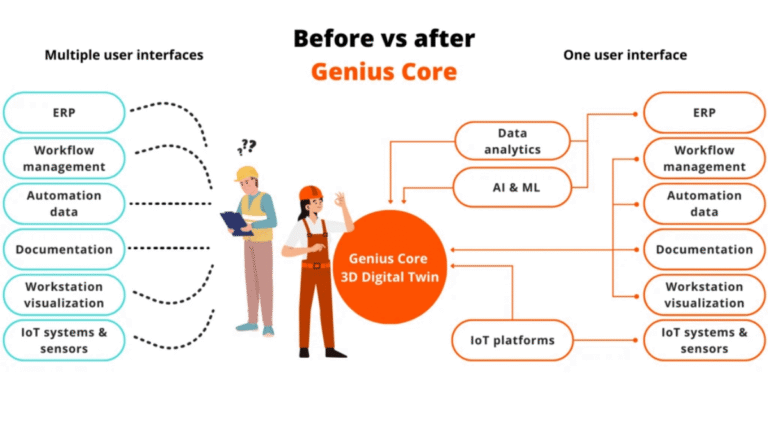
Genius Core is a configurable SaaS Digital Twin platform designed for industrial environments. It can bring together information from existing systems such as ERP, MES, EAM, and SCADA, as well as data collected from machines and other industrial sources.
During implementation, the Digital Twin can be configured around the customer’s production environment and selected use cases. This includes setting up parameters, defining relationships between components, configuring data flows, and connecting operational information to the assets and processes it describes.
The resulting information can then be presented through a visual representation of the production environment. Instead of requiring users to navigate several separate systems to understand what is happening, relevant data can be accessed in the context of the corresponding machines, production areas, and processes.
A configurable approach also supports gradual expansion. An implementation can begin with a defined production area or use case and later be extended with additional assets, integrations, visualizations, and operational applications as requirements develop.
This reduces the need to build every new Digital Twin environment entirely through customer-specific development. At the same time, configuration can reflect the differences between manufacturing environments and the information different users need in their daily work.
For Process Genius, Digital Twin implementation is therefore not only about creating a digital representation of a factory. It is about connecting relevant industrial information to the physical production context and making that information easier for people to access, understand, and use.
If you are considering how a Digital Twin could be implemented in your manufacturing environment, contact Process Genius to discuss your existing systems, data sources, use case, and implementation requirements.
FAQs
What is digital twin implementation?
Digital twin implementation is the process of creating a digital representation of physical assets, processes, or facilities using real-time operational data. It involves connecting industrial systems, IoT devices, and software platforms into one centralized environment for monitoring, analysis, and decision-making.
How do you implement a digital twin in manufacturing?
Digital twin implementation in manufacturing typically starts by integrating data from machines, PLCs, SCADA systems, MES, ERP platforms, and IoT sensors. The collected data is then visualized in a centralized platform, allowing manufacturers to monitor production, improve visibility, and optimize operations in real time.
What are the benefits of implementing a digital twin?
Implementing a digital twin can improve operational visibility, reduce downtime, support predictive maintenance, and enhance decision-making. Organizations also gain better access to real-time production data, improved process transparency, and greater control over operational performance.
What systems are needed for digital twin implementation?
A digital twin can integrate with existing industrial and enterprise systems such as ERP, MES, SCADA, BMS, IoT platforms, databases, APIs, and OPC UA-enabled devices. Platforms like Genius Core™ help unify these systems into one connected operational environment.
How long does digital twin implementation take?
The timeline for digital twin implementation depends on the complexity of the environment, the number of systems involved, and integration requirements. Many organizations begin with a pilot project or a single production area before expanding the digital twin across the entire facility.