
What is the difference between ERP, MES, MRP and a Digital Twin?
ERP, MES, MRP and Digital Twin technologies support different parts of industrial operations. They are not competing systems, but complementary tools that help organizations manage business resources, production, materials and operational data from different perspectives.
An ERP system provides a broad view of business processes such as finance, procurement, supply chain and other company resources. MES focuses more closely on what is happening in production and provides real-time visibility into shop-floor operations, performance and quality. MRP supports production planning by helping manufacturers manage material requirements, inventory and production schedules. A Digital Twin, in turn, creates a virtual representation of physical equipment, processes or environments and connects this representation with real-time and historical operational data.
If you want a deeper introduction to the concept itself, our guide to what a Digital Twin is explains how virtual representations, real-time data and physical assets are connected in practice.
Comparison: ERP vs MES vs MRP vs Digital Twin
System | Main purpose | Typical focus | Role in manufacturing |
|---|---|---|---|
ERP | Managing company resources and core business processes | Finance, procurement, supply chain, HR, services and business data | Creates a company-wide view of resources and business processes |
MES | Managing and monitoring production execution | Shop-floor activities, production status, performance and quality | Provides real-time visibility and control of production operations |
MRP | Planning materials required for production | Demand, inventory, material requirements, production schedules and bill of materials | Helps ensure that required materials are available when production needs them |
Digital Twin | Monitoring, analyzing and optimizing physical assets and processes | Real-time and historical operational data, equipment and production environments | Creates a virtual operational view that can combine data from physical assets and other industrial systems |
The main difference is therefore the level and type of information each system is designed to manage. ERP focuses primarily on business and resource management, MRP on materials and production planning, and MES on the execution of production. A Digital Twin adds another layer by placing operational information into the context of physical equipment, processes and environments.
This means that a Digital Twin does not normally replace ERP, MES or MRP. Instead, it can complement them by bringing information from different systems together with real-time operational data. This creates a clearer view of what is happening in production and gives teams additional context for monitoring, analysis, optimization and decision-making. The current article already establishes this integration idea by describing how Digital Twins can combine ERP, MES and MRP data into a single operational view.
What is ERP?
ERP (Enterprise Resource Planning) is a system used to manage and connect an organization’s core business processes. In manufacturing companies, ERP typically brings together information related to finance, procurement, inventory, supply chain, human resources, sales and other business functions. The goal is to provide a consistent view of company resources and support planning and decision-making across the organization.
In manufacturing, ERP can help answer questions such as what materials have been purchased, what is available in inventory, what orders need to be fulfilled and how resources are allocated. However, ERP data does not necessarily provide a detailed real-time view of what is happening with individual machines, production lines or processes on the shop floor. This distinction is important when comparing ERP with systems that operate closer to production.
ERP and Digital Twin
ERP and Digital Twin technologies work with different types of information. ERP primarily manages business and resource data, while a Digital Twin connects information to physical assets, processes and operational environments. By combining these perspectives, manufacturers can better understand how business decisions and production performance influence each other.
For example, ERP information about orders, inventory or procurement can be combined with real-time production and equipment data in a Digital Twin. Instead of viewing information only in separate systems, users can access relevant data in the context of the production environment and gain a clearer understanding of current operations.
This becomes especially valuable when information from multiple business and industrial systems needs to be brought together. Data integration makes it possible to connect these different sources and create a more consistent flow of information between business systems and operational environments.
What is MES?
MES (Manufacturing Execution System) is a system used to manage, monitor and document production activities on the shop floor. While ERP operates mainly at the business and resource-planning level, MES works closer to production by providing visibility into how manufacturing operations are actually being executed.
An MES can collect and organize information about production orders, machine and process status, production progress, quality and other shop-floor activities. This helps production teams understand what is happening in manufacturing, identify deviations and respond to operational issues more quickly. The existing article similarly positions MES as a system that provides real-time visibility and control over production operations.
In practice, MES therefore creates an important connection between production planning and production execution. It helps transform production plans into activities on the shop floor while generating production data that can be used to evaluate performance and improve operations.
MES and Digital Twin
MES and Digital Twin technologies both improve visibility into production, but they serve different purposes. MES focuses primarily on managing and tracking production execution, whereas a Digital Twin provides a virtual representation of physical assets, processes or production environments and can combine information from multiple systems with real-time operational data.
When MES data is connected with a Digital Twin, information about production status and performance can be viewed in the context of the actual production environment. This can make complex production information easier to interpret and help users understand how individual machines, processes and production areas contribute to overall performance.
A Digital Twin can also combine MES information with historical and real-time data from equipment and other industrial systems. This creates additional opportunities for industrial data analytics, helping manufacturers identify trends, investigate performance issues and use production data to support continuous improvement.
What is MRP?
MRP (Material Requirements Planning) is a system used to determine what materials are needed for production, how much is required and when those materials should be available. It helps manufacturers coordinate material requirements with production schedules so that the necessary components and raw materials are available when they are needed.
MRP typically uses information such as production demand, inventory levels, lead times and the bill of materials (BOM) to calculate material requirements. This helps organizations plan purchasing and production more effectively, reduce the risk of material shortages and avoid unnecessary inventory.
While ERP manages a broader range of company resources and MES focuses on production execution, MRP has a more specific planning role. Its primary purpose is to ensure that material availability supports the production plan. This reflects the current article’s positioning of MRP around production planning, scheduling and inventory management.
MRP and Digital Twin
MRP and Digital Twin technologies approach manufacturing from different perspectives. MRP uses information about demand, inventory and material requirements to support production planning, while a Digital Twin connects data to physical equipment, processes and production environments.
Combining these perspectives can give manufacturers additional operational context for planning. For example, information about production conditions, equipment performance or process status can help teams understand whether planned production can be carried out as expected and where operational constraints may affect the plan.
The key difference is therefore not simply that MRP looks at the near future while a Digital Twin looks further ahead. Rather, MRP focuses on what materials production requires, while a Digital Twin provides insight into how physical production assets and processes are actually performing. A Digital Twin can use both real-time and historical operational data for monitoring, analysis and optimization, complementing the planning information provided by MRP. The current article already makes this distinction between MRP’s material-planning role and the Digital Twin’s use of operational data.

How ERP, MES, MRP and Digital Twins work together
ERP, MES, MRP and Digital Twin technologies serve different purposes, but their value increases when information can move between them. Instead of treating business planning, material planning, production execution and operational monitoring as separate activities, manufacturers can connect data from these systems to create a more complete view of production.
ERP can provide business and resource information, MRP contributes material and production-planning data, and MES provides information about production execution on the shop floor. A Digital Twin can bring relevant information from these systems together with data from machines, sensors and other industrial sources and place it in the context of the physical production environment.
The result is not a replacement for ERP, MES or MRP. Rather, the Digital Twin can provide an additional operational layer through which information from different systems becomes easier to visualize, analyze and use in day-to-day decision-making. This develops an idea already present in the current article, which explains that a Digital Twin can integrate ERP, MES and MRP data into a single operational view.
Connecting business, production and operational data
Manufacturing data is often distributed across multiple systems. ERP contains information about business processes and resources, MRP supports material planning, MES records production activities, while machines and industrial equipment generate operational data directly from the production environment.
Connecting these sources makes it possible to examine production from several perspectives at the same time. For example, production status from MES can be viewed alongside equipment data, while information from ERP or MRP provides additional context about orders, materials and production requirements.
This connected approach reduces the need to search for information across separate systems and helps users understand relationships between planning, production and equipment performance more quickly.
IT and OT integration
Connecting ERP, MES and MRP with machines and production equipment also requires communication between information technology (IT) and operational technology (OT). IT systems typically manage business, planning and enterprise data, while OT systems interact more directly with machines, sensors, control systems and physical industrial processes.
Industrial IoT can help bridge these environments by collecting and transferring data from connected equipment and sensors so that operational information can be used by other systems and applications.
In industrial environments, interoperability is also important because machines and systems may come from different manufacturers and use different technologies. Standards such as OPC UA can support standardized data exchange between industrial equipment, control systems and software applications.
One operational view for decision-making
Once relevant information from business, planning, production and operational systems is connected, a Digital Twin can present it within a common operational context. Users can see the information that is relevant to their role without necessarily navigating between multiple separate systems.
This can help production, maintenance and management teams identify problems more quickly, understand how operational events affect production and make decisions based on a broader set of information. Instead of simply collecting more data, the goal is to make connected data easier to interpret and use.
A Digital Twin ontology can support this by defining how business data, production information, physical assets, processes, and other operational concepts are related within the Digital Twin.
This is also where the distinction between integration and visualization becomes important: ERP, MES and MRP continue performing their specialized functions, while the Digital Twin provides a contextual view that helps users understand how information from those systems relates to physical operations.

What does a Digital Twin add to ERP, MES and MRP?
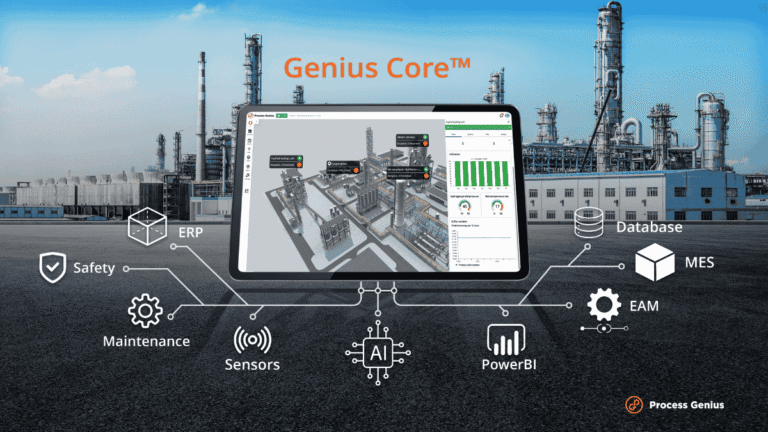
ERP, MES and MRP systems each provide valuable information for managing manufacturing operations, but that information often remains tied to the specific purpose and interface of each system. A Digital Twin can complement these systems by connecting their data with information from physical equipment and processes and presenting it within a visual operational environment.
This gives manufacturers another way to use existing data. Instead of looking only at individual records, reports or system dashboards, users can relate information to the machines, production lines and processes it describes. Real-time and historical data can then support monitoring, analysis and optimization across the production environment. The current article already distinguishes MES’s real-time visibility from a Digital Twin’s ability to combine real-time and historical data for analysis and optimization.
Real-time operational visibility
A Digital Twin can combine information from ERP, MES and MRP with operational data from machines, sensors and other industrial systems. This helps users see what is happening in production and understand that information in the context of physical assets and processes.
For example, production status can be connected with equipment conditions, process values or other operational information. This can make deviations easier to identify and give production and maintenance teams a clearer view of situations that require attention.
When this visibility is extended across production assets and processes, the Digital Twin can support industrial monitoring by bringing relevant operational information into a common, understandable view.
Data visualization and analysis
One of the key advantages of a Digital Twin is that data can be presented in the context of the physical environment it represents. Instead of interpreting information only through spreadsheets, reports or separate dashboards, users can connect data to relevant equipment, production areas and processes.
Visualization alone, however, is not the goal. Combining real-time and historical information can help manufacturers identify trends, compare performance and investigate why production behaves differently under different conditions.
Simulation and optimization
A Digital Twin can also provide a foundation for analyzing different operational scenarios. Depending on the implementation and available data, manufacturers can use models and historical information to evaluate how changes in production conditions, processes or equipment could affect performance.
This allows teams to explore potential improvements before making changes to physical operations. Simulation and scenario analysis can therefore support production optimization, capacity planning and more informed decision-making.
If an organization is considering how these capabilities can be introduced into its existing technology environment, a structured Digital Twin implementation helps define the required data sources, integrations, use cases and operational objectives.
Predictive maintenance
When operational and historical equipment data is available through a Digital Twin, it can also support maintenance decisions. Changes in equipment condition or performance can be identified over time, helping maintenance teams recognize developing problems and plan interventions before failures lead to unplanned downtime.
This creates a natural foundation for predictive maintenance, where equipment data is used to assess future maintenance needs and anticipate potential failures.
ERP, MES, MRP and Digital Twins in connected manufacturing
Modern manufacturing increasingly depends on the ability of different systems, machines and data sources to work together. ERP, MES and MRP each manage an important part of the manufacturing environment, while operational technologies generate continuous information about equipment, processes and production conditions.
Connecting these different sources helps manufacturers move away from isolated systems and fragmented information. Instead, business, planning, production and operational data can be used together to create greater visibility across manufacturing operations. This is a central principle of connected manufacturing, where machines, systems, people and data form an interconnected production environment.
A Digital Twin can provide a practical interface for this connected environment by bringing relevant information from different systems into the context of physical production. ERP, MES and MRP continue to perform their specialized functions, while the Digital Twin helps users visualize and interpret information from those systems alongside real-time operational data.
This approach also reflects the broader development of Industry 4.0, where connected equipment, industrial data, automation and digital technologies are increasingly used together to improve visibility, flexibility and decision-making in manufacturing.
For manufacturers, the goal is therefore not necessarily to replace existing systems, but to make better use of the information they already contain. By integrating ERP, MES, MRP and industrial data with a Digital Twin, organizations can create a more accessible operational view and provide different teams with relevant information for monitoring, analysis and continuous improvement.
For practical examples of how this approach can be applied to production environments, see our guide to Digital Twins in manufacturing.
Process Genius Genius Core is a 3D Digital Twin platform that brings data from existing industrial systems into a visual operational environment. It can complement ERP, MES, MRP and other data sources by making relevant information easier to access and understand in the context of actual equipment, processes and production environments.
Learn more about Genius Core and its integration possibilities.
What is the difference between ERP, MES and MRP?
ERP, MES and MRP support different levels of manufacturing operations. ERP manages broader business processes and resources, such as finance, procurement, inventory and supply chain activities. MES focuses on managing and monitoring production execution on the shop floor, while MRP focuses on material requirements and production planning. The systems have different purposes but can work together as part of the same manufacturing environment.
What is the difference between ERP and MES?
ERP focuses primarily on company-wide business processes and resource management, while MES operates closer to production. MES provides visibility into how production is being executed on the shop floor, including production status, performance and quality. ERP therefore provides the broader business context, while MES provides more detailed information about manufacturing operations.
What is the difference between MES and MRP?
MRP helps manufacturers determine what materials are required, how much is needed and when those materials should be available. MES focuses on what happens when production is actually being executed. In simple terms, MRP supports production and material planning, while MES supports production execution and shop-floor visibility.
Does MES replace ERP?
No. MES and ERP perform different but complementary functions. ERP manages broader business resources and processes, while MES provides more detailed visibility and control at the production level. Manufacturers can integrate ERP and MES so that relevant business and production information can move between the two systems.
Does a Digital Twin replace ERP or MES?
No. A Digital Twin normally complements ERP and MES rather than replacing them. ERP continues to manage business processes and resources, while MES manages production execution. A Digital Twin can combine relevant information from these systems with operational data and present it in the context of physical equipment, processes and production environments.
Can a Digital Twin integrate with ERP, MES and MRP?
Yes. A Digital Twin can integrate relevant data from ERP, MES and MRP systems into a common operational view. This allows manufacturers to combine business, planning and production information with operational data and gain greater visibility across the production environment.
What data can a Digital Twin receive from ERP and MES?
The exact data depends on the systems and use case. ERP can provide information related to areas such as orders, inventory, procurement and other business processes, while MES can provide information about production status, production execution, performance and shop-floor activities. A Digital Twin can combine relevant information from these systems with data from machines, sensors and other industrial sources to provide operational context.
Why combine a Digital Twin with existing manufacturing systems?
Manufacturers often already have valuable information distributed across ERP, MES, MRP and other industrial systems. A Digital Twin can bring relevant information together and connect it with the physical production environment. This can make data easier to access and interpret while supporting monitoring, analysis, optimization and more informed decision-making.