
Improving health, safety, and environmental performance is key to keeping people safe, staying compliant with regulations, and creating a workplace that values safety and responsibility. It helps prevent accidents, protects the environment, and keeps everything running smoothly. Plus, it saves money in the long run by avoiding costs from incidents and boosts the company’s reputation as a responsible and reliable organization. It’s about making the workplace better for everyone while also ensuring long-term success.
What is HSE?
Health, Safety, and Environment (HSE) is a structured approach to managing workplace hazards, protecting employee well-being, and reducing the environmental impact of industrial operations. In manufacturing, HSE management combines policies, procedures, risk assessments, and preventive measures to create safer working conditions for employees, contractors, and visitors.
Manufacturing facilities present a wide range of occupational health, industrial safety, and environmental challenges. These may include exposure to hazardous substances, moving machinery, excessive noise, physical strain, and emissions or waste generated during production.
Effective HSE management helps manufacturers identify and control these risks, comply with applicable regulations, and promote a workplace culture where health, safety, and environmental responsibility are part of everyday operations.
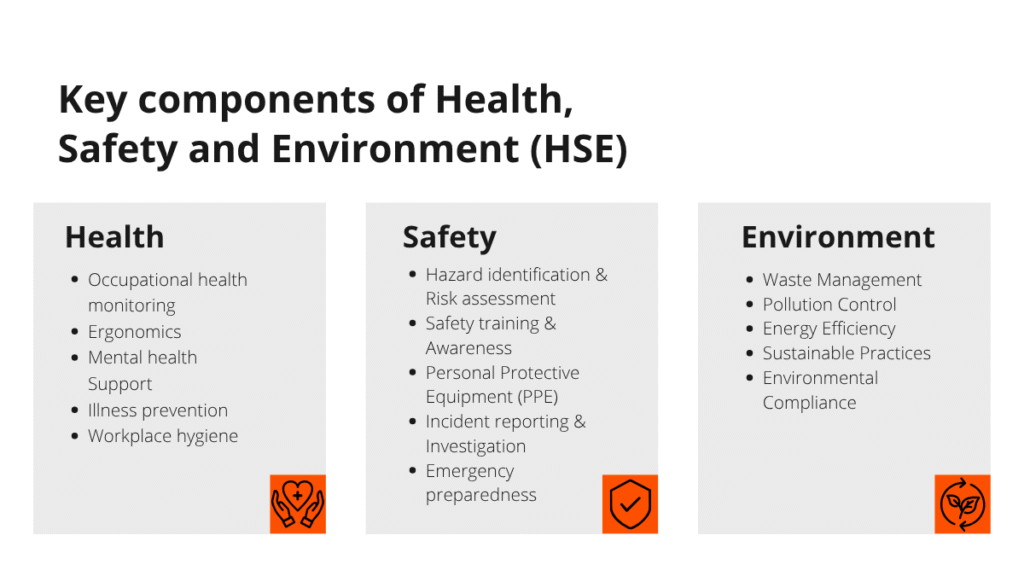
HSE consists of three interconnected components: Health, Safety, and Environment.
Health: Protecting Employee Well-Being
The health component of HSE focuses on preventing work-related illnesses and protecting employees’ physical and mental well-being.
In manufacturing environments, occupational health risks may arise from prolonged exposure to noise, dust, chemicals, repetitive movements, physically demanding tasks, or poorly designed workstations.
Manufacturers can address these risks through workplace health assessments, ergonomic improvements, exposure monitoring, appropriate protective equipment, and employee health programs.
For example, a production facility may introduce noise monitoring and hearing protection measures to reduce the risk of hearing damage among employees working near heavy machinery.
Protecting occupational health also involves recognizing psychosocial risks, such as excessive workloads and fatigue, that can affect employee well-being and safe working practices.
Safety: Preventing Workplace Accidents
The safety component focuses on preventing workplace accidents, injuries, and other incidents that could harm employees, contractors, or visitors.
Industrial safety is particularly important in manufacturing facilities, where workers may operate heavy machinery, handle hazardous materials, work at heights, or interact with automated production equipment.
Effective safety management involves identifying workplace hazards, assessing risks, implementing appropriate controls, and ensuring that employees understand safe working procedures.
Common industrial safety measures include machine guarding, equipment inspections, emergency response planning, safety training, and lockout/tagout procedures for controlling hazardous energy during maintenance.
For example, a manufacturer may use machine guards and safety interlocks to reduce the risk of employees coming into contact with moving equipment.
A strong safety culture encourages employees to report hazards, follow established procedures, and participate in improving workplace safety.
Environment: Managing Environmental Impacts
The environmental component of HSE focuses on reducing the negative effects of manufacturing activities on the surrounding environment.
Industrial operations may generate emissions, wastewater, hazardous waste, and other environmental impacts. Manufacturing processes also consume energy, water, and raw materials that require responsible management.
Environmental protection measures can include monitoring emissions, managing industrial waste, preventing chemical spills, improving resource efficiency, and complying with applicable environmental regulations.
For example, a manufacturing facility may monitor wastewater quality and implement preventive measures to reduce the risk of pollutants entering the surrounding environment.
Environmental HSE management also connects with broader environmental sustainability initiatives, which help manufacturers explore ways to reduce resource consumption and support the transition toward more sustainable industrial operations.
By addressing health, safety, and environmental responsibilities together, manufacturers can develop a more coordinated approach to managing operational risks and improving workplace conditions.

Why Is HSE Management Important in Manufacturing?
Effective Health, Safety, and Environment (HSE) management is essential for protecting employees, maintaining safe production environments, and reducing the operational and environmental risks associated with manufacturing activities.
Industrial facilities often involve complex machinery, hazardous substances, automated equipment, and interconnected production processes. Without appropriate preventive measures, these conditions can expose employees to workplace hazards and increase the likelihood of accidents, occupational illnesses, and environmental incidents.
A structured approach to HSE management helps manufacturers identify potential risks, establish safer working practices, and continuously improve their health, safety, and environmental performance.
Protecting Employees and Preventing Workplace Injuries
The primary purpose of HSE management is to protect people from work-related injuries and illnesses.
Manufacturing employees may encounter hazards associated with moving machinery, chemical exposure, excessive noise, manual handling, and maintenance activities.
Regular risk assessments, appropriate safety controls, employee training, and clear operating procedures help organizations reduce exposure to these hazards.
By prioritizing employee health and safety, manufacturers can create working environments where employees are better equipped to recognize risks and perform their tasks safely.
Reducing Operational Disruptions
Workplace accidents and safety-related incidents can affect more than the individuals directly involved. They may also interrupt production, require equipment shutdowns, delay deliveries, or create additional operational costs.
For example, an incident involving unsafe machinery may require a production line to stop while the situation is investigated and appropriate corrective actions are implemented.
Effective HSE management helps manufacturers identify hazardous conditions and address them before they contribute to serious incidents.
Although HSE measures cannot eliminate every operational risk, preventive safety practices can support more stable and reliable manufacturing operations.
Meeting Regulatory and Environmental Responsibilities
Manufacturing companies must comply with applicable occupational health, workplace safety, and environmental regulations.
These requirements may cover machinery safety, hazardous substance handling, employee training, waste management, emissions, and emergency preparedness.
A structured HSE management approach helps organizations identify relevant obligations, maintain necessary documentation, conduct inspections, and monitor whether established procedures are being followed.
It also supports environmental responsibility by encouraging manufacturers to assess the potential effects of their operations and implement measures to reduce environmental harm.
Specific legal requirements depend on the country, industry, and nature of the manufacturing activities.
Strengthening Workplace Safety Culture
HSE management is most effective when health, safety, and environmental responsibilities are integrated into everyday operations.
A positive safety culture encourages employees to report hazards, communicate concerns, follow established procedures, and participate in improving workplace conditions.
Management commitment is equally important. Employees need appropriate training, clear responsibilities, and confidence that reported safety concerns will be addressed.
When organizations encourage open communication and involve employees in identifying risks, HSE becomes a shared responsibility rather than simply a compliance requirement.
Supporting Continuous Operational Improvement
HSE management also provides valuable information for improving manufacturing operations.
Safety inspections, incident investigations, near-miss reports, and environmental monitoring can reveal recurring problems or weaknesses in existing procedures.
By reviewing this information, manufacturers can identify improvement opportunities, prioritize corrective actions, and evaluate whether preventive measures are effective.
For example, repeated reports of unsafe access to a particular machine may indicate a need to redesign the workstation, improve protective barriers, or revise maintenance procedures.
Using HSE information to guide decisions supports a more proactive approach to managing workplace risks and improving operational practices.

HSE Compliance and Safety Management Requirements
HSE compliance management involves identifying, implementing, and maintaining the health, safety, and environmental requirements that apply to an organization’s operations.
In manufacturing, these requirements can cover workplace conditions, machinery safety, hazardous substances, employee training, environmental protection, and emergency preparedness.
Effective HSE compliance management goes beyond maintaining documentation. Manufacturers must assess workplace risks, establish appropriate preventive measures, communicate safety requirements, and regularly verify that their procedures remain effective.
Because legal obligations vary by country, industry, and type of industrial activity, organizations should identify the regulations relevant to their specific facilities and operations.
Regulatory Requirements and Applicable Standards
Manufacturing companies must comply with applicable occupational health, workplace safety, and environmental legislation.
Depending on the jurisdiction and manufacturing processes involved, relevant requirements may address:
- Hazard communication: Ensuring employees understand the risks associated with hazardous chemicals and receive appropriate handling instructions and training.
- Process safety: Managing risks associated with industrial processes involving hazardous substances, potentially dangerous operating conditions, or major accident hazards.
- Personal protective equipment (PPE): Selecting and using appropriate protective equipment when workplace risks cannot be adequately controlled through other measures.
- Confined space safety: Establishing procedures to control risks associated with restricted spaces, including hazardous atmospheres, oxygen deficiency, and difficult emergency access.
- Machinery and equipment safety: Protecting workers from moving machinery, hazardous energy, and other equipment-related risks.
- Environmental protection: Managing emissions, waste, chemical storage, and other environmental impacts in accordance with applicable requirements.
Alongside legal obligations, manufacturers may use recognized management system standards to organize their HSE activities.
For example, ISO 45001 provides a framework for occupational health and safety management systems, while ISO 14001 addresses environmental management systems.
These standards can support systematic risk management, performance evaluation, and continuous improvement. However, certification to a management system standard does not automatically demonstrate compliance with every applicable legal requirement.
Risk Assessments, Inspections, and Documentation
Risk assessments are an essential part of effective HSE compliance management.
Manufacturers need to identify workplace hazards, evaluate the likelihood and potential consequences of harmful events, and determine which preventive or protective measures are necessary.
For example, a risk assessment of a production line may identify hazards associated with moving machinery, maintenance access, chemical handling, or excessive noise.
The findings should inform appropriate control measures, such as equipment guarding, safer working procedures, improved ventilation, or restrictions on access to hazardous areas.
Regular workplace inspections and safety audits help organizations verify whether these measures are implemented and functioning as intended.
Manufacturers can also conduct compliance gap analyses to compare existing practices with applicable legal requirements, internal policies, and relevant management system standards.
Important HSE documentation may include:
- Workplace risk assessments and hazard registers.
- Safety procedures and operating instructions.
- Inspection and audit records.
- Employee training records.
- Incident and near-miss reports.
- Corrective-action records.
- Environmental monitoring and compliance documentation.
Maintaining accurate, accessible records supports internal reviews, regulatory inspections, and ongoing improvements to HSE management.
Employee Training and Safe Working Procedures
Even well-designed safety procedures are less effective if employees do not understand the hazards associated with their work.
Manufacturers should provide appropriate HSE information, instruction, training, and supervision based on employees’ responsibilities and the risks they may encounter.
Training may cover safe machinery operation, hazardous substance handling, PPE use, emergency procedures, and the reporting of unsafe conditions.
Employees performing specialized tasks, such as maintenance involving hazardous energy or work in confined spaces, may require additional training and authorization.
Clear communication is equally important.
Safety instructions should be understandable, accessible, and updated when equipment, production processes, or workplace conditions change.
Employees should also have opportunities to raise safety concerns and contribute to improving established procedures.
By combining regulatory awareness, systematic risk assessments, regular inspections, and effective employee training, manufacturers can establish a stronger foundation for HSE compliance and workplace safety management.

How to Improve HSE Performance: Practical Steps
Improving Health, Safety, and Environment (HSE) performance requires more than complying with regulations or introducing individual safety measures. Manufacturers need a systematic approach to identifying risks, protecting employees, monitoring workplace conditions, and continuously improving operational practices.
The following six steps provide a practical framework for strengthening HSE management in manufacturing facilities.
1. Identify Hazards and Assess Workplace Risks
The first step is to identify potential hazards and evaluate the risks associated with manufacturing activities.
Workplace hazards may include moving machinery, hazardous chemicals, excessive noise, slippery surfaces, electrical equipment, and physically demanding tasks. Environmental risks, such as chemical spills, emissions, or improper waste handling, should also be considered.
Manufacturers can identify these hazards through workplace inspections, employee feedback, equipment assessments, and reviews of previous incidents.
Once hazards have been identified, organizations should assess their potential consequences and the likelihood of harmful events occurring. This helps prioritize risks and determine where preventive measures are most urgently needed.
For example, a manufacturing facility may identify an unguarded moving component on a production line and assess the risk of employees coming into contact with it during normal operation or maintenance.
Risk assessments should be reviewed when equipment, production processes, or workplace conditions change.
2. Implement Appropriate Risk Controls
After identifying and assessing risks, manufacturers need to implement measures that eliminate hazards or reduce exposure to them.
A useful approach is the hierarchy of controls, which prioritizes more effective preventive measures over those that rely primarily on individual behavior.
The hierarchy generally follows this order:
- Elimination: Remove the hazard entirely where possible.
- Substitution: Replace a hazardous material, process, or activity with a safer alternative.
- Engineering controls: Use physical or technical measures, such as machine guards, ventilation systems, or safety barriers.
- Administrative controls: Establish safe working procedures, access restrictions, training, and appropriate supervision.
- Personal protective equipment (PPE): Provide suitable protective equipment for remaining risks.
For example, installing an effective machine guard is generally preferable to relying solely on warning signs or employee instructions to prevent contact with moving equipment.
Manufacturers should also verify that implemented controls function as intended and remain effective as operating conditions change.
3. Train Employees and Strengthen Safety Communication
Employees need to understand the hazards associated with their tasks and know how to perform their work safely.
HSE training should reflect employees’ responsibilities, the equipment they operate, and the risks present in their working environment.
Training topics may include machinery safety, hazardous substance handling, emergency procedures, PPE use, and the reporting of unsafe conditions.
Clear operating instructions, accessible safety documentation, and appropriate supervision help employees apply these practices consistently.
Manufacturers should also communicate changes in procedures, equipment, or workplace conditions that may introduce new risks.
For example, when a production facility introduces a new automated machine, employees should receive relevant training before operating, cleaning, or maintaining the equipment.
Effective communication works in both directions. Employees should be encouraged to raise safety concerns, ask questions, and suggest improvements without fear of retaliation.
4. Report Incidents and Near Misses
Incident reporting is essential for understanding what can go wrong in a manufacturing environment and preventing similar situations in the future.
Organizations should establish clear procedures for reporting workplace injuries, equipment-related safety incidents, environmental events, and near misses.
A near miss is an unplanned event that did not result in harm or damage but had the potential to do so.
For example, an employee may notice a loose component falling from equipment without anyone being injured. Although no injury occurred, the event may reveal a maintenance or workplace safety problem that requires investigation.
Incident and near-miss reporting should focus on identifying contributing factors and improving preventive measures rather than assigning blame.
Depending on the severity and nature of an event, follow-up activities may include:
- Investigating the circumstances and contributing causes.
- Reviewing existing risk assessments and safety procedures.
- Identifying corrective and preventive actions.
- Assigning responsibility for implementing improvements.
- Verifying that the actions taken have reduced the identified risk.
Manufacturers should also review incident trends to identify recurring hazards or weaknesses in existing controls.
5. Monitor HSE Performance and Review Results
HSE performance should be monitored regularly to determine whether existing safety and environmental measures are effective.
Manufacturers can use workplace inspections, safety audits, employee feedback, incident reports, and environmental measurements to evaluate conditions across their facilities.
Relevant performance indicators may include the number of reported near misses, completion of safety inspections, corrective-action closure rates, occupational injury trends, and environmental incidents.
Monitoring should not focus exclusively on accidents that have already occurred. Proactive indicators, such as completed risk assessments and preventive actions, can provide additional information about how effectively HSE processes are being managed.
In industrial facilities, industrial monitoring can also provide information about equipment and process conditions that may be relevant to workplace safety or environmental protection.
For example, monitoring temperature, pressure, or gas concentration may help operators recognize conditions that require investigation or intervention.
However, monitoring information is only useful when organizations establish appropriate alert thresholds, responsibilities, and response procedures.
Regular reviews help manufacturers identify improvement opportunities and adjust their HSE practices as operational risks evolve.
6. Establish a Continuous Improvement Process
Long-term HSE improvement requires a structured management approach with clear responsibilities, measurable objectives, and regular performance reviews.
A formal HSE management system can help manufacturers coordinate policies, risk assessments, employee training, inspections, incident reporting, and corrective actions.
Management should establish appropriate HSE objectives, assign responsibilities, and provide the resources needed to implement preventive measures.
Organizations can then evaluate progress through internal audits, performance indicators, employee feedback, and management reviews.
For example, if repeated inspections identify unsafe storage practices in a particular production area, the manufacturer may revise storage procedures, improve workplace layouts, provide additional training, and verify whether the changes are effective.
Continuous improvement also requires updating HSE practices when new machinery, production processes, materials, or environmental risks are introduced.
By combining risk prevention, employee involvement, performance monitoring, and systematic reviews, manufacturers can develop a proactive approach to HSE management that supports safer and more responsible industrial operations.

How to Measure HSE Performance
Measuring Health, Safety, and Environment (HSE) performance helps manufacturers understand whether their preventive measures are effective and where further improvements are needed.
HSE performance measurement involves collecting and reviewing information about workplace hazards, safety activities, incidents, and environmental conditions. By tracking relevant key performance indicators (KPIs), organizations can identify recurring problems, evaluate corrective actions, and support more informed decisions.
A useful HSE measurement approach combines leading indicators, which reflect preventive activities and risk controls, with lagging indicators, which describe incidents or outcomes that have already occurred.
Leading and Lagging HSE Indicators
Leading indicators help manufacturers evaluate activities and conditions associated with preventing workplace accidents, occupational illnesses, and environmental incidents.
Examples of leading HSE indicators include:
- Safety inspection completion rate: The percentage of planned workplace inspections completed within a defined period.
- Corrective-action closure rate: The proportion of identified corrective actions completed within the required timeframe.
- Employee safety training completion: The percentage of relevant employees who have completed required training.
- Risk assessment completion: The proportion of scheduled or required risk assessments completed.
- Reported hazards and near misses: Information about potentially unsafe conditions and events that employees identify before serious consequences occur.
Near-miss reporting requires careful interpretation. An increase in reported near misses does not necessarily mean workplace safety is deteriorating. It may also indicate that employees are becoming more willing to report hazards and that the organization’s reporting culture is improving.
Lagging indicators, by contrast, measure events or outcomes that have already occurred.
Common examples include:
- Workplace injuries: The number or rate of recorded occupational injuries.
- Lost-time injuries: Injuries resulting in employees being unable to perform their normal work for a defined period.
- Occupational illnesses: Reported work-related health conditions.
- Environmental incidents: Events such as chemical spills, unauthorized releases, or other harmful environmental occurrences.
- Safety-related operational interruptions: Production disruptions resulting from accidents or hazardous conditions.
Manufacturers should avoid relying on a single indicator to evaluate overall HSE performance. For example, a low number of reported accidents does not necessarily demonstrate that all workplace hazards are adequately controlled.
Combining leading and lagging indicators provides a more balanced understanding of preventive activities, existing risks, and actual safety outcomes.
Using HSE Data to Identify Improvement Opportunities
Collecting HSE data is only the first step. Manufacturers also need to analyze the information and use the findings to improve workplace conditions.
Relevant information may come from incident reports, safety inspections, risk assessments, employee feedback, equipment measurements, and environmental monitoring systems.
When this information is reviewed together, organizations can identify recurring hazards, compare performance across production areas, and evaluate whether corrective measures are producing the intended results.
For example, a manufacturing facility may discover that near misses occur more frequently around a particular production line during maintenance activities. Reviewing inspection findings, incident reports, and operational conditions may help identify contributing factors, such as restricted access, inadequate procedures, or insufficient protective measures.
Industrial data analytics can support this process by helping manufacturers organize and interpret information from different operational systems, identify patterns, and investigate unusual trends.
However, data analysis should complement rather than replace workplace inspections, employee involvement, and professional safety assessments.
To make HSE performance measurement useful, manufacturers should establish clear indicators, define responsibilities for reviewing results, and ensure that identified issues lead to appropriate corrective actions.
Regularly reviewing HSE data helps organizations evaluate progress, adjust preventive measures, and support continuous improvement in workplace health, industrial safety, and environmental performance.

What Happens When HSE Risks Are Not Managed?
Failing to identify and manage Health, Safety, and Environment (HSE) risks can have serious consequences for manufacturing companies, their employees, and the surrounding environment.
In industrial facilities, unmanaged hazards may lead to workplace accidents, occupational illnesses, environmental incidents, and disruptions to production. Inadequate HSE practices can also expose organizations to regulatory penalties, legal liabilities, and long-term reputational damage.
The potential consequences of ineffective HSE management include:
- Workplace injuries and occupational illnesses: Uncontrolled hazards involving machinery, chemicals, excessive noise, or unsafe working conditions can result in injuries, long-term health problems, or fatal accidents.
- Regulatory penalties and legal consequences: Failure to meet applicable occupational safety or environmental requirements may result in fines, enforcement actions, legal proceedings, or restrictions on operations, depending on the jurisdiction and circumstances.
- Production interruptions and additional costs: Workplace accidents and hazardous conditions may require equipment shutdowns, investigations, repairs, or changes to production processes. These disruptions can affect productivity and increase operating costs.
- Reduced employee trust: Repeated safety concerns or inadequate responses to reported hazards can weaken employee confidence in management and negatively affect workplace morale.
- Reputational damage: Serious safety incidents, environmental violations, or poor working conditions can affect relationships with employees, customers, business partners, and other stakeholders.
- Environmental harm: Poor control of hazardous substances, emissions, wastewater, or industrial waste can cause pollution, damage surrounding ecosystems, and create additional remediation responsibilities.
For example, an undetected chemical leak in a manufacturing facility may expose employees to hazardous substances, interrupt production, and cause environmental contamination. Depending on the circumstances, the incident could also trigger regulatory investigations and corrective-action requirements.
These consequences highlight why HSE management should focus on preventing incidents rather than responding only after harm has occurred.
By identifying hazards early, implementing appropriate controls, and regularly reviewing HSE performance, manufacturers can reduce the likelihood and potential severity of workplace and environmental incidents.

How Digital Tools and 3D Digital Twins Support HSE Management
Manufacturing companies often manage health, safety, and environmental information across multiple systems, sensors, documents, and reporting tools. When this information is fragmented, employees may need to switch between applications to identify hazards, review incidents, or understand conditions across a production facility.
Digital HSE management tools can help manufacturers organize relevant information, improve visibility into workplace risks, and support more coordinated decision-making.
One approach involves using a 3D Digital Twin to represent an industrial facility digitally and connect relevant operational information to its physical environment.
By combining visual context with data from connected systems, manufacturers can make HSE information easier to locate, interpret, and use in everyday operations.
Centralizing HSE Information from Multiple Systems
Industrial facilities generate information from production equipment, monitoring systems, safety inspections, incident reports, and environmental measurements.
When this information is stored in separate applications, it can be difficult to obtain a consistent overview of workplace conditions and ongoing HSE activities.
Digital platforms can help address this challenge by bringing relevant information together in a shared environment.
For example, a manufacturing facility may need to review equipment conditions, reported hazards, and safety-related events associated with a particular production area.
Presenting this information in one place can reduce the need to navigate multiple systems and help employees access the context required for further investigation.
Centralized information can also support communication between production, maintenance, and HSE teams, particularly when several departments need to coordinate responses to the same issue.
Visualizing Hazards and Safety-Related Events
A visual representation of a manufacturing facility can help employees understand where hazards, incidents, and other safety-related information are associated with physical locations.
Instead of relying exclusively on separate reports or lists, manufacturers can use a 3D environment to provide spatial context for relevant HSE information.
For example, a hazardous chemical storage area may be associated with safety instructions, handling requirements, and other relevant documentation.
Similarly, reported hazards or safety-related events can be connected to specific equipment or areas within a facility.
This approach can make it easier to communicate information about workplace risks and help employees locate relevant safety guidance.
However, digital visualization should complement established risk assessments, workplace inspections, employee training, and physical safety controls rather than replace them.
Monitoring Conditions and Coordinating Responses
Monitoring equipment and environmental conditions can help manufacturers recognize changes that may require attention.
Depending on the facility and its connected systems, relevant information may include temperature, pressure, gas concentrations, equipment status, or other process measurements.
When appropriate data and analytical capabilities are available, anomaly detection can help identify unusual patterns that may warrant further investigation.
For example, an unexpected change in process temperature or pressure could prompt operators to review equipment conditions and determine whether additional action is necessary.
Not every unusual measurement indicates a safety hazard, and not every hazardous condition can be identified through automated monitoring. Alerts and analytical findings therefore need to be interpreted within the relevant operational and safety context.
Digital tools can also support the coordination of responses by making safety-related events, associated information, and follow-up activities more accessible to the teams responsible for managing them.
How Process Genius Supports HSE Workflows
The Process Genius 3D Digital Twin platform helps manufacturing companies integrate and visualize information from different industrial systems within a shared digital environment.
The platform provides several capabilities that can support HSE-related workflows:
- Hazard information and safety communication: Relevant information about chemical hazards, safe handling procedures, and employee training can be made accessible to support workplace safety communication.
- Hazard visualization and risk management: Points of Interest (POIs) and Events can be used to associate information and events with relevant locations or assets in the digital environment.
- Production environment monitoring: The Production Data layer provides access to production-related information that can help users review operating conditions.
- Incident-related information management: Exception Event Handling can support the handling of exceptional events, including information relevant to occupational accidents and other safety-related situations.
- Customizable information views: Widgets, reports, and diagrams can help present relevant information in formats suited to different operational tasks.
By bringing together information from multiple sources, Process Genius can help manufacturers improve the visibility and accessibility of HSE-related data while supporting communication between responsible teams.
The platform is a tool for organizing, visualizing, and working with information. Effective HSE management still requires appropriate safety procedures, trained personnel, risk controls, and compliance with applicable regulations.
To explore how these capabilities could support your manufacturing operations, book a consultation or schedule a demo.
FAQs
What is HSE performance in industrial operations?
HSE performance refers to how effectively an organization manages health, safety, and environmental risks to protect people, assets, and the environment.
How can companies improve HSE performance?
HSE performance can be improved by implementing safety procedures, monitoring risks in real time, training employees, and using connected data to identify and prevent incidents.
Why is HSE important in industrial environments?
Strong HSE practices reduce workplace incidents, ensure regulatory compliance, protect employees, and support safe and efficient operations.
How does real-time data help improve HSE performance?
Real-time data from sensors and systems helps detect unsafe conditions, monitor environmental parameters, and enable faster response to potential risks—supporting proactive safety management.
Can digital twins be used to monitor HSE performance?
Yes. Digital twin solutions can combine real-time data with visual environments to monitor assets, track safety conditions, and improve situational awareness—helping teams identify risks and respond more effectively.