
In today’s fast-paced world of Artificial Intelligence and other big leaps in robotics and automation, Digital Twins have quickly gained popularity among manufacturers. For those in charge of manufacturing plants that produce more data every millisecond than that of any other industry, it is crucial to access the most relevant information to make swift decisions with confidence [1].
In short, Digital Twins are virtual replicas of physical assets that provide real-time insights and performance data. This enables businesses to perfect their processes from a single machine or a line to large, scattered manufacturing plants, ultimately leading to value creation for both businesses and their customers alike.
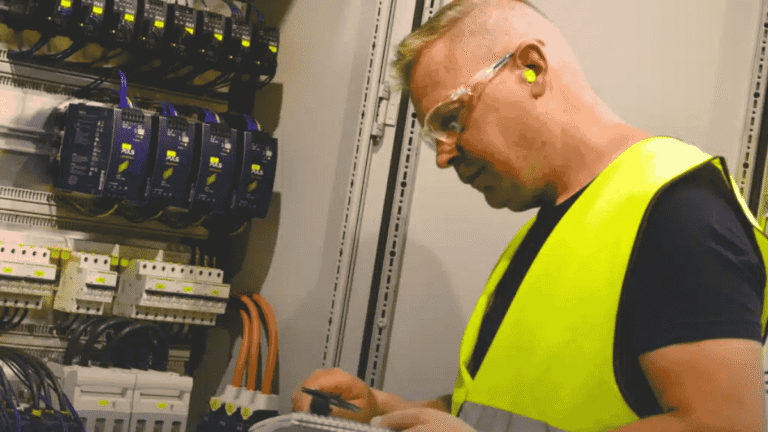
My daily work is all about making the concept of Digital Twins a reality by collecting machine data and integrating it into the virtual replicas. Join me in this article as I provide you with an exclusive behind-the-scenes look at a typical day in my role, shedding light on the tasks faced by professionals like me within the industry.
To wrap it up, you will also learn how Process Genius’ new Genius Core 3D Digital Twin platform helps industrial professionals like you streamline data integration and management.
A day of a Field Service Specialist
My typical day involves a combination of on-site visits, data mapping and planning, sensor installation, data collection, and platform configuration to support our customer’s onboarding.
I usually start the day by visiting the customer’s manufacturing facilities to check data sources, install sensors, and collect data from various machines and equipment using different methods. These methods include both wired and wireless solutions. The data collected typically includes performance metrics, operational parameters, and environmental conditions critical for monitoring and analyzing machine behavior.
Once the data is collected, it is transmitted to the Digital Twin platform often using simple sensors for older machines, and for more modern machines protocols like OPC UA and Beckhoff TwinCAT. This ensures secure and reliable communication between the physical assets and their digital counterparts.
A Digital Twin that is easy to configure on your own.
The next step is to configure the platform, which our customers can do it either by themselves or ask our team for help. In fact, we provide ready API access allowing you to connect your existing data sources and systems, automate data flows, and ensure high security in one centralized interface. However, I am also there to help our customers should they need it in configuring the platform to match their needs to track OEE, downtime, and other key metrics.
In fact, increasingly more of our average manufacturing customers start their onboarding straight from this phase with automated machine data collection already on place. More commonly this data is integrated into other systems as well, such as an ERP, MES, EAM, or SCADA software, or a combination of all these applications.
What the configuration itself involves is setting up parameters, defining relationships between components, and setting up data flows to create a dynamic virtual representation (a real Digital Twin if you will) of the manufacturing environment.
By aligning the physical assets with their digital representations, the Digital Twin lays the foundation for predictive maintenance, performance optimization, and many other use cases that drives operational excellence for our customers. For example, with accurate data capture and visualization combined with notification and workflow triggers, a 30% improvement in productivity can be realized in a matter of months.
There is a huge shift from customer-specific solutions towards software as a service
Implementing Digital Twin has usually meant another cumbersome IT project. But in our customers’ case, it is a very straightforward and intuitive process using the Genius Core platform. This is because we at Process Genius have seen that there is a huge shift in the market from customized, customer-specific solutions towards cloud-based SaaS (software as a service) solutions.
Ever since our company was founded, we have met customers who have spent years trying to use tailored, custom solutions to make some sense of data collected from their assets. This has cost them years of custom development and integration before obtaining initial value, a terrible misallocation of resources for any manufacturer.
Thus, it is no surprise that nowadays the average manufacturing customer has started to demand swift changes to the standard and we’re here to deliver exactly that.
Benefits of centralizing data visualization
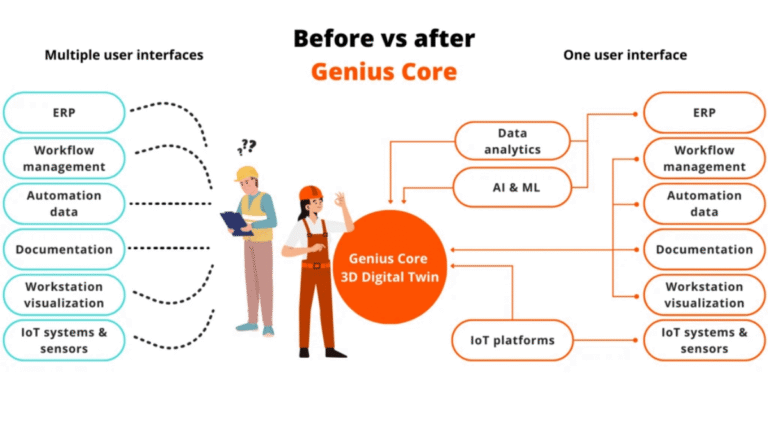
Genius Core is a cloud-based, multi-tenant SaaS platform that offers you an easy-to-use visual layer with integration capabilities that enable seamless connectivity with ERP, EAM, SCADA, and other systems, sensors, and data sources. You can easily import data, configure data mappings, and synchronize information in real-time to create a unified and exact representation of your operations within the platform.
This way we want to ensure you have a smooth transition to a Digital Twin solution that matches your needs. You know exactly what the costs are and get to enjoy the benefits of lower platform and development costs and faster innovation cycles.
In my experience, centralizing data visualization with Genius Core platform offers many benefits for industrial professionals like you looking to streamline their daily data management. By combining data from diverse sources into a single platform, you can gain a holistic view of your operations, find patterns and trends, and extract actionable insights to improve efficiency and productivity.
Our software provides you with a centralized hub for storing, analyzing, and visualizing machine data, enabling you to access real-time information, historical trends, and predictive analytics in a single interface. This centralized approach simplifies data integration, reduces silos, and promotes cross-functional collaboration among different teams involved in manufacturing operations.
“For example, with accurate data capture and visualization combined with notification and workflow triggers, a 30% improvement in productivity can be realized in a matter of months.” – Jani Siren, Field Service Specialist, Process Genius
Genius Core 3D Digital Twin platform offers a comprehensive suite of features designed to empower you with advanced tools for data integration, visualization, and analysis. Key features of the platform include real-time monitoring, predictive maintenance, and HSEQ, enabling manufacturers to gain valuable insights, refine operations, and drive excellence.
Furthermore, the platform’s advanced capabilities empower you to make data-driven decisions and refine processes with confidence. By using the centralized data infrastructure of Genius Core, you can unlock new opportunities for efficiency gains, cost savings, and competitive advantage in today’s rapidly evolving manufacturing landscape.
If you’re enthusiastic to learn more about the ways how to collect and use machine data efficiently, let’s connect on LinkedIn.
If you want to see how all this could work in your factory, please don’t hesitate to book a call with our experts – we’re more than happy to help you!
FAQs
What is digital twin implementation?
Digital twin implementation is the process of creating a digital representation of physical assets, processes, or facilities using real-time operational data. It involves connecting industrial systems, IoT devices, and software platforms into one centralized environment for monitoring, analysis, and decision-making.
How do you implement a digital twin in manufacturing?
Digital twin implementation in manufacturing typically starts by integrating data from machines, PLCs, SCADA systems, MES, ERP platforms, and IoT sensors. The collected data is then visualized in a centralized platform, allowing manufacturers to monitor production, improve visibility, and optimize operations in real time.
What are the benefits of implementing a digital twin?
Implementing a digital twin can improve operational visibility, reduce downtime, support predictive maintenance, and enhance decision-making. Organizations also gain better access to real-time production data, improved process transparency, and greater control over operational performance.
What systems are needed for digital twin implementation?
A digital twin can integrate with existing industrial and enterprise systems such as ERP, MES, SCADA, BMS, IoT platforms, databases, APIs, and OPC UA-enabled devices. Platforms like Genius Core™ help unify these systems into one connected operational environment.
How long does digital twin implementation take?
The timeline for digital twin implementation depends on the complexity of the environment, the number of systems involved, and integration requirements. Many organizations begin with a pilot project or a single production area before expanding the digital twin across the entire facility.